THE SUSHI GUIDE – A LIST OF ALL TYPES OF SUSHI 寿司
At over 200 terms I have attempted to compile as comprehensive a list of sushi fish and a guide to sushi terms and sushi terminology as possible. Sushi and its related fish can become confusing and many diners and restaurants, and lesser chefs, casually mistake and confuse the terms and the fish. The guide goes beyond sushi staples like shrimp, salmon and tuna. Many of the items may not be available locally or only have Japanese terms. Where possible I have tried to indicate seasonality and availability to the alphabetical list of sushi terms and added my own subjective experience tasting the item. Incidentally, in Japan sushi has its own unit of measurement called Kan カン, which acted as a unit of measurement in the Edo Period equal to 3.75 Kg for fish or the equivalent to either 1 or 2 nigirizushi. Some believe it is 1 sushi, while others believe it is for 2 given how they typically come in a set comprised of pairs.
Where possible purchase or order male fish. Female fish give part of their nutrients, and associated taste, to their eggs or roe. Additionally, it has been said that if one can pick a specific cut or part of a fish the rear side nearer to the tail is likely better. It has been moving more and is hence less rough.
I recommend treating sushi with respect and focusing on quality as opposed to surrendering to the temptation of low-grade or cheap fish at the hands of uninformed restaurant owners and their chefs. Inside-out rolls with the nori hidden within, California rolls and the like laden with avocado and salmon, chushi or kushi and all-you-can-eat joints are particular offenders.
I have added a downloadable document at the bottom of the sushi guide should you wish to download the below as a reference guide to types of sushi.


A
Abura Bozu 油坊主 Skilfish This fish, often called Butterfish, but more accurately belonging to oilfish variety is valued by some for its oily and buttery taste. This is why it is confused with escolar Abura-sokomutsu (アブラソコムツ). Like escolar, it is sometimes served as White Tuna (Tombo) or Shiro Maguro or called Shizu. I was recently surprised to find it at a high end Sushi restaurant because it is reputed to be difficult for humans to digest. Even though it is fished in the south of Pacific it is not served or eaten in Japan. Canada recommends that Butterfish’s fattier parts be excluded when the fish is served.
Ainame 鮎並 Rock Trout or Greenling It is sometimes called a ‘fat fish’ and eaten in the spring time. This fish lives in rocky areas exclusively near Japan and Korea. A family member is Hokke, or Atka Mackerel or Arabesque Greenling, which is distinguished from Ainame by having an ‘arrow shaped’ fin.
Aji 鯵 Spanish or Horse Mackerel A medium oily fish that sushi bars serve with grated ginger and citrus sauce. Aji is a small fish served in the summer. The word means ‘taste’ in Japanese. Known also as Jack Fish, as it is not truly a Mackerel, Aji has a yellow line running across its length. Aji may be infested especially in its mouth and, as such, needs to be properly cleansed. May be referred to as Maaji or Kuroaji. Aoaji is blue Aji. Kiaji (‘yellow aji’) is the more expensive variety that inhabits bays.

Akaamadai 赤甘鯛 See Amadai
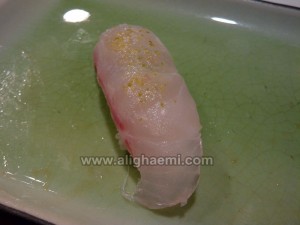

Akaei 赤鱏 Stingray This fish is rarer, but when eaten it may be accompanied by ponzu sauce. The Skate Fish – a relative – is also not highly regarded, but is becoming more prevalent. It is called Eihire or Ei-Hire.
Akagai 赤貝 Red Clam or Bloody Clam It is typically available in the winter, spring and summer. Like all clams it is high in texture and, therefore, chewy. Akagai is also called Ark Shell or Blood Cockles. Aka-gai is quite easy to identify as it looks like a wilted flower, of course, once it is taken out of its shell. The taste is sweeter than most clams. It might be served vinegared and could be a sushi or sashimi. It is called ‘red,’ but the colour is more typically off-orange. Akagai is sometimes called Tama or ‘ball’ owing to its round shape. The stringy attachments of the akagai, which are sometimes called its legs, are called Himo ひも. One might read warnings about this clam as they may contain hepatitis A owing to the depth and low oxygen environment where they habitate. Akagai stems from Miyagi prefecture and China.

Akagai in Tokyo, Japan
Akamachi アカマチ Ruby Snapper This Snapper has a lighter shade of red on its scales. It is Hamadai outside Okinawa.
Akamadai 赤真鯛 Red Seabream The ‘red’ Seabream, a fish that can come in red or black. See ‘Madai.’ This fish could alternatively be served with yuzu juice to good effect.
Akami 赤身 Red Tuna or Red Fish All types of red tuna are called Akami or Akame. This family of fish is at its height in the winter. See Maguro as an example. Akami is the reddest part and leaner. Another example is Kintokidai.

Left To Right: Otoro, Chutoro And Magurozuke
Akayagara 赤矢柄 Cornet Fish Akayagara is fished near Japan. It is called Yagara in its shortened form. It is a healthy fish to eat.
Akoudai 赤魚鯛 Red Rockfish or Rose Rockfish or Rock Cod This winter fish is best cooked. Also known as Menuke or Baramenuke, this bright red fish is related to Kinmedai.
Amadai 甘鯛 Tile Fish or Horse Head or Blanquillo This fish is suitable for sashimi and available in the winter. It is a relative of Tai and is ‘sweet tai.’ It is found in Western Japan. It is also known as Akaamadai.
Ama ebi 甘海老 Sweet Shrimp or Pink Shrimp It is well cleansed and served raw at good sushi restaurants. It is alternately written as Amaebi and found in colder waters.

Jumbo Amaebi

Jumbo Amaebi With Deep Fried Head
Ami 醤蝦 Opposum Shrimp This is a very small shrimp typically used in cured form.
Anago 穴子 Sea Water Eel or Conger Eel A lighter and fluffier version of its more popular cousin, unagi. It is best found and eaten in the summer. It is topped with green onions and a sauce people mistake for teriyaki sauce – ungenuine restaurants might actually be serving teriyaki. The sauce is made from soy sauce, sugar, salt and MSG. The sauce that it is served with is a mixture of salt, sugar and MSG with soy sauce. The sauce is called Tsume 詰め, which is short for Nitsume 煮つめ. Anago is served simmered or pre-cooked and served grilled towards the end of a sushi course. Anago traditionally comes from Tokyo Bay, but is now farmed as well. Anago may be called Hakarime as well.

Ankimo 鮟肝 Monkfish’s Liver Ankimo is served after simmering. It is a pate often served with Ponzu sauce (a Japanese citrus-based vinegar sauce) after being rinsed with Sake. The fish (Anko) is caught through indiscriminate bottom trawling and best avoided.
Anko 鮟鱇 Monkfish, Frogfish or Angler Also spelt Ankou or Ankoo, like Unagi and Fugu Anko has its own dedicated restaurants. It might be used as a stew as well. I believe this metre-long fish’s liver is used for making pate. The fish is found in the winter.
Aodai 青鯛 Blue Snapper Also called Blue Fusilier this fatty white fish is caught near Kagoshima. It is found in the summer.
Aoyagi 青柳 Blue Clam Also known in Japan as Bakagai (‘stupid clam’ or sometimes known as ‘crazy clam’). Aoyagi is named after the Japanese town, in Chiba Prefecture, where the clam is abundant. It is also known as the Mactra, Round Clam or Surf Clam. However, this clam is caught all along the eastern coast of Japan.

Aoyagi

Aoyagi
Arakabu アラカブ Scorpion Fish This small and spotty looking fish is available in the winter. It is also called Kasago as Stinger Fish. It is fished in the Fukuoka waters. Expect a firm fish.
Asari 鯏 Clam It is also called Manila Clam. These could be eaten raw or steamed.
Awabi 鮑 Abalone Awabi is an expensive and tasty snail. It is quite free of contaminants. It has a strong sea aroma and is sometimes salted and served in soy sauce. The best Awabi is available in the early summer. Awabi is likely the oldest component of sushi to be eaten in Japan. Awabi is expensive as it needs to be scraped and detached from its habitat. Moreover, it is endangered and has seen a collapse of its species. Farmed varieties are making it more accessible however. Tokobushi is the round Abalone of Japan. Megai is red abalone and Kuroawabi is the black variety. Mushi Awabi is steamed Abalone.
Ayu 鮎 Sweet Fish It is small and grilled member of the Trout (Masu) family. Ayu is rarely eaten raw. It has the appearance of Unagi when served and is a relative of Trout. This small river fish is best eaten in the summer. The Ayu Family is not highly regarded. In a whimsical scene in The Makioka Sisters the unmarried sister rejects a suitor whose work is studying Ayu.
B
Baigai バイ貝 Japanese Ivory Shell It is akin to a small snail and prized in Japan as Sashimi.
Bera べら Wrasse or Gilthead This inexpensive fish, which is also called kyusen 九仙, is often used for oshizushi. It is found in the summer. Akabera is the female and Aobera is the male.
Bintoro ビントロ Albacore This is a warm water fish with an oily, sometimes deemed buttery, taste. Bintoro is often flamed or grilled. Bintoro specifically comes from Bincho Maguro (Albacore).
Bincho Maguro 鬢長 Albacore. It may be called Binnaga Nigiri.
Bora 鯔 Mullet This fish is found in shallower waters near Hokkaido and more seldomly near Fukuoka. It is steamed and cooked as often as it is eaten as sushi or sashimi. The fish may be referred to as Ezobora, ‘Ezo’ being the olden name for Hokkaido. Young Bora are called Subashiri.
Botan Ebi ボタンエビ Botan Shrimp. This larger Prawn is found in the winter.

Buri 鰤 Adult Yellowtail This yellowtail is expected to be 90 cms or longer and approximately 5 kgs in weight. It is best eaten in the winter when it is most fatty. Most Buri is farmed. In Western Japan it is a New Year’s meal. Buri is redder than the pink/white mixture of most Hamachi or the white colour of Inada. Several areas, including Ehime Prefecture, are promoting fish with a ‘Mikan’ (Japanese orange) taste. In this case, Mikanburi is fed oranges to give it a very slightly citrusy flavour.
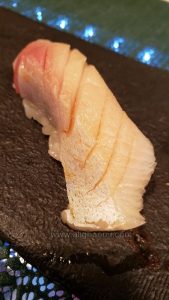
Mikanburi in Vancouver, Canada
Budai ブ鯛 Parrotfish This beautiful fish is found near coral reefs in the Pacific and Indian Oceans and so named because of its vibrant colours, which also change.
C
Chippu 紅鮭 Sockeye Salmon This fish is also known as Red Salmon or Himemasu. Chippu’s name stems from Hokkaido.
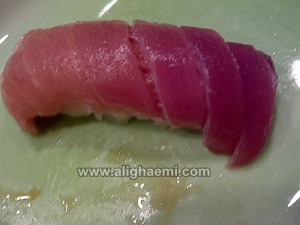
Chutoro 中とろ Marbled Belly of Tuna near the belly Expensive medium fatty cut of Tuna from near the flank and belly of the fish. While Otoro, the fattiest cut, is most prized the Chutoro is a close second. Chutoro is the fatty part of tuna, which lines the inner portion of the said fish’s belly.
D
Datsu 駄津 Needlefish A lone ‘D’ entry, this long fish is often confused with Sayori. Datsu have two ‘beaks.’ It is often used for making Kamaboko, fish paste loaf as its nutritional use is limited. It is called Shijar in Okinawa. It is also sometimes called Houndfish.
E
Ebi 海老 Tiger Shrimp or Prawn It is typically served cooked (boiled), but the raw form is also eaten as sashimi. Ebi is also served in tempura batter. Akaebi refers to ‘red shrimp.’ Oniebi or Spiny Shrimp is best found in spring. It is 15 cms long almost.
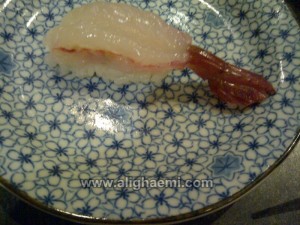

Akaebi
Engawa 縁側 Dorsal muscle of Hirame Fluke or Halibut’s dorsal muscle. It is available year round, but is more common in the summer. It has a tougher texture due to its nature. Karei also has Engawa. The Japanese word for a traditional porch in a Japanese house is also ‘engawa.’ Why the coincidence? It is actually because many believe the striped appearance of the cut of fish resembles the pattern of the porch.


Enzara エンザラ Enzara This fish is eaten both grilled and raw. Owing to its blackened appearance it traditionally has been shunned; however, it is seeing something of a surge in popularity due to being served by a Chiba Prefecture chain of kaitenzushi (sushi on conveyor belts), called the Yamato-group, and subsequent televised publicity. It was previously used in Kamaboko (fish cake) or simply consumed by the fishermen. Nowadays it is increasingly served as nigiri or in tataki form. Enzara is part of the barracuda family of fish. Its name is derived from that of an area in Tateyama in Chiba where, in addition to Izu Peninsula, it is mostly caught. Other names for Enzara are Yaki or Kuro-sanma.

Enzara in Narita, Japan
F
Fugu 河豚 Blowfish or Putterfish or Swell Fish or Globefish How would you like to be paralysed? In these parts, Fugu is more likely to be a restaurant name than a menu item, but in Japan specialty Fugu restaurants often incorporate the fish’s name into theirs. Most Fugu is caught near Shimonoseki in Southwestern Japan. Parts of Blowfish, like the livers, intestines, skin (in certain genus) or the ovaries, are toxic and cannot be commonly sold as it can poison its eater if incorrectly cut or prepared. According to Japan’s Ministry Of Health, Labour And Welfare Fugu was the top cause for intoxication in that country, although the incidence overall was very low. See the report here: http://www.mhlw.go.jp/english/topics/foodsafety/poisoning/dl/Food_Poisoning_Statistics_2009.pdf. Chefs need to be specially licensed to cut and prepare Fugu. As such, the fish should not pose any danger if the tetrodotoxins have been correctly removed by a licenced chef. The sale of the genus is banned by the European Union. Fugu is served at specialty restaurants in Japan, which are called Fuguya. These restaurants are not difficult to find, but the fish is expensive given the licensing of the establishment and chefs. Report has it that the Emperor Of Japan is banned from ingesting Fugu due to its toxic nature. Blowfish Sashimi is called Tessa (Kansai) or Fugusashi i.e. Fugu No Sashimi (Kanto). Tessa refers to Tetsu and sashimi. Tetsu being ‘iron’ the adjective here refers to a gun. This is a reference to the deadly nature of the fish. One popular type of the fish is Tora Fugu or Tiger Blowfish. Fugu Mirin Boshi refers to the snack or appetizer that is dried Blowfish seasoned in Mirin or Sake. Fugu is served as sashimi followed by cooked recipes. The fish gets its name from the manner it inflates when it senses danger or is frightened. Due to its mild taste the fish is eaten for thrills and chewed slowly for the umami flavour.
Blowfish is available in the winter. Fugu is actually the Japanese sound for ‘river pig’ owing the fish’s looks. In Kansai Fugu may be called Teppoo which again means ‘rifle’.


Funa 鮒 Crucian or Carp Funa is typically used in an olden type of sushi called Funazushi or Narezushi. It is traditionally eaten in its preserved i.e. fermented form cured in salt and fermented in vinegared rice. Used for Funazushi or Narezushi, ancient forms of sushi, Funa is essentially a form of Goldfish best eaten in the winter and found in the Kyoto area and Shiga Prefecture.

G
Gatsuo 鰹 Bonito See Katsuo (also known as Hagatsuo when referring to Skipjack Tuna).
Geso 下足 Squid Legs or Tentacles Typically served as part of a stew or fried. It is a short form of Gesoku.

Gindara 銀鱈 Sablefish This fish is most commonly served as blackcod, although many restaurants substitute other fish for the same menu item. Also known as Coalfish, it is an oily fish, but could contain high levels of lead as it is in the upper food chain of fish. It is found in Northern Japan or in the Northern Pacific.
H
Hagatsuo 歯鰹 Skipjack Tuna A light fish that is confused with Gatsuo. Hagatsuo is striped. Hatsugatsuo, the ‘first catch,’ of the fish is in spring. “I would be willing to pawn my wife for a taste of hatsu-gatsuo.” is an old Japanese saying.
Hamachi はまち Yellowtail A popular sushi item, despite it typically being farmed, which is beautiful in its white to yellow to red and pink transition. The word ‘hamachi’ technically refers to younger Yellowtail, but is commonly used to refer to all Yellowtail fish. It is 30 to 60 centimeters long and approximately 3 kg. The term is often interchangeable with Inada. The best and fattier Hamachi, which might be Buri, is found in the winter in the Pacific Ocean. Yellowtail is more popular and more expensive the bigger and the older it gets. In short, however, one type or the other of yellowtail is available at some time in the year. Nonetheless, the main season for Hamachi is winter. Negihama, one of the more popular rolls in North America, is virtually unknown in Japan. Simply replace with Negitoro. Most hamachi is farmed and enthusiasts prefer the older relative, Kanpachi. The fish has recently been found as far north as Hokkaido due to global warming. Young Yellowtail is called Wakashi in Eastern Japan.

Smoked Hamachi in Toronto, Canada
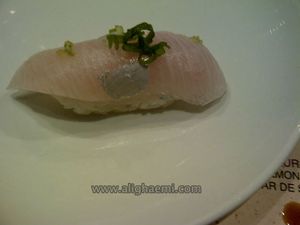
Hamachi Kama はまちカマ Yellowtail Collar The ‘collar’ of Yellowtail served grilled. This piece and part are not premium choices.
Hamachi Sunazuri はまち砂ズリ Belly Of Yellowtail The fatty part of Yellowtail.
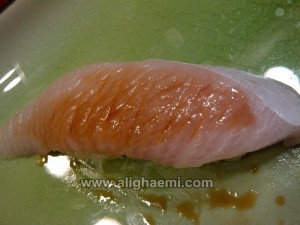
Hamadai 浜鯛 Red Snapper A precious fish that is more often confused than served correctly. Red Snapper is also called Akamatsu. See Akaamachi.
Hamaguri 蛤 Venus Clam or Hard Clam An unpopular item owing to its strong taste. It is a hard shell. This winter clam is sometimes skewered. The Hamaguri has for decades been an allegory for the female sex organ in Japan. This crude joke is included in the Ozu Yasujiro film Early Summer as well. The same item – along with Toro – is also ordered by name in the director’s film, Late Autumn. The most common Hamaguri is Nihamaguri and available during the spring.

Hamaguri in Tokyo, Japan
Hamo 鱧 Pike Eel This eel looks like a sea snake and best eaten in the summer. It is the ‘dagger
-tooth’ relative of Anago. It is found in Central Japan and now also in the Indian Ocean and further west.
Hata 羽太 Grouper Hata is a shortened form of Mahata.
Hatahata 鰰 Sandfish Hatahata is found in the north of Japan. Best prepared in Yamagata and Akita. It is more often used as an ingredient of hotpots. It used to be called Satake after a Japanese feudal lord who shipped them. Stocks have dwindled greatly in recent years.
Hawara American Mackerel Hawara is a more plain version of Saba and fished in North America. This is the North American name.
Haze 鯊 Goby Also may be called Mahaze. Often used for tempura. An alternate name is Mudfish.
Hikari Mono 光り物 Shiny Things This Is A Generic Term For Silver Fish Like Saba, Aji Or Kohada. It is also called Hikarimono.
Himejako ヒメジャコ Giant Clam As the name suggests these clams are quite large and could be as long as a metre and a half. Their shells are also valued.
Himokyu ひもきゅう Clam Mussels This is typically served as a Temaki with cucumbers. I was offered this roll in Japan when Hotate was unavailable.
Hiiragi 鮗 Spotnape or Ponyfish This fish is found in the winter and has an oval shape. In Tokyo it is called Gichi, while in Chiba it is called Gira, in Aichi Zenme and it is Nekoumatagi (‘cat steps over it’) in Shizuoka. The last name is indicative of the bony and cheaper nature of this fish.
Hiramasa 平政 Yellowtail Amberjack This fish is a member of the Amberjack family, but is less oily than its relatives Hamachi and Buri. Nowadays, Hiramasa is often the Japanese name for the Australian farmed Amberjack known as King Fish.
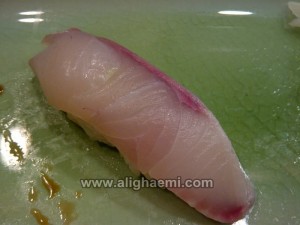
Hirame 平目 Fluke or Flounder It is the name for the white flat fishes that are typically served at the beginning of a course of sushi. Due to Flounder living in the sands at the bottom of the ocean the diner might discern a faint earthy taste. Hirame’s season is the cold of winter or autumn. Halibut, which is often what people think Hirame (i.e. ‘flat eyes’ in Japanese Kanji) is, should be called Ohyo. Even the film Jiro Dreams Of Sushi mistakes the fish on the screen. It is fished on North America’s East Coast. Flat fish or Flatheads are generally called ‘Kochi.’ This is a ‘horizontal’ fish. Shitabirame or Tongue-Sole looks like a shoe’s sole and lives in Western Pacific. This last fish is found in spring and summer. Makogarei (Marbled Flounder) is the Hirame of late spring.


Hirame
Hokkigai ホッキ貝 Surf Clam Hokkigai is most popular in the Hokkaido area of Japan. What is served is the top part of the clam. This part of the body is immersed in water to dispel and separate the sand and other sea particles. The colour transitions from pink to red to crimson. The peak season for Hokkigai is late spring or early summer. It can be eaten as sashimi. It may be called Ubagai (‘old woman clam’).
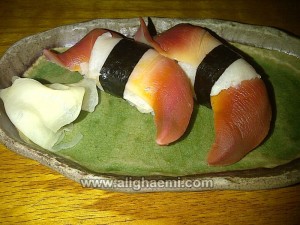
Hotate or Hotategai 帆立貝 Bay Scallops This is likely the best-known shellfish. When Westernized it is served with mayonnaise or hot sauce. It is popular as a roll. Hotategai is Giant or Sea Scallops. Yude Hotate is Boiled Scallop sushi.
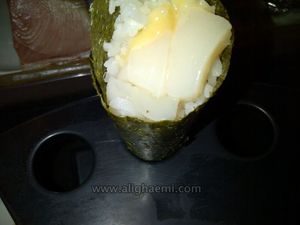
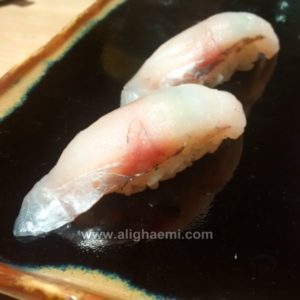
Houbou ほうぼう Red Gurnad It is also known as Gurnet or Sea Robin. This rare fish is little-known and served as sushi in rare instances like at Choshi, Chiba or in Mie Prefecture. It is relatively inexpensive, however, given the low demand. Look for it in the winter. The chewy fish could also stem from Kyushu, which is the case for the photographs here.

I
Ibodai 疣鯛 Namazutterfish This is the Japanese butterfish and not known for its quality. It is found in the spring and summer.
II-dako 飯蛸 Young Octopus The small young Octopi are usually appetizers.
Ika 烏賊 Squid or Cuttlefish Ika is served cooked as a sushi or sashimi or an ingredient in soup or hand rolls. Ika is also served as a tempura. Dried squid is called Surume and eaten as a snack. One type of Ika is ‘Yariika’ otherwise known as arrow or spear squid. Yariika can be served in a broth in the form of noodles. Connoisseurs believe the best season for Ika is the spring, but it is also widely available in the summer. Also called Koika. Hotaruika, or Firefly Squid, are found deep down in the Pacific Ocean. It is so named because it could be lit as it attracts fish to eat or a mate. They are eaten as sushi or sashimi, but more often consumed boiled. Ika Tempura is called Ikaten incidentally. The brighter the ika the better. Ika could be white or Shiroika or red, which is Akaika. Sumiika or ‘ink squid’ is more expensive. Aoriika is more chewy. One is encouraged to chew this type of Ika as much as possible in order to extract more sweetness from this variety of squid. Banno Mongo or Mongo Ika is simply squid that has been cleaned and scored in order to allow for better seasoning or marination.


Ika With Uni

Yariika in Vancouver, Canada

Aoriika in Toronto, Canada
Ikura イクラ Salmon Roe The name likely stems from the Russian word for ‘caviar’ or ‘ikra’ which is fish roe – hence the katakana. It is usually served as Ikura Gunkan Maki (battleship roll). Ikura also means ‘how much?’ It is likely the highest source of fish oil, but it would correspondingly be high in cholesterol. Ikura is sometimes decoratively used on top of Japanese dishes. Ikura is sometimes served with grated daikon (Japanese radish) and called Ikura Oroshi. When the chum salmon roe is salted while still inside the sac it is called Sujiko.

Inada 鰍 Young Yellowtail This Yellowtail is around a year old and one-foot in length. It is the less expensive or less popular of the Amberjack family. It is fished in the summer and autumn in Japan. The term is interchangeable with Hamachi. Inada is more white than pink or red.
Isaki いさき Grunt Also known as Chicken Grunt, Three Line Grunt or Pigfish, Isaki is found in the sub-Antarctic near Chile, Argentina and Brazil, as well as near Japan’s main island and Fukuoka in the summer and autumn. It is off-white and moderately fatty. Its taste is akin to Tai and is chewy. It may be referred to as Knifejaw. When grilled the Japanese call it Yakishimo.

Ise-ebi 伊勢海老 Crawfish Actually a spiny Lobster, but with little meat. Eaten raw or grilled. It is found from November to March and is expensive.
Ishigaki-gai 石垣貝 Bering Sea Cockle This cockle has a fine taste and is similar to Torigai, but is less chewy yet thicker. One is advised to chew as much as possible in order to bring out the umami. Its peak season is summer and autumn. It is also called Ezo Ishikage-gai with ‘Ezo’ referring to Hokkaido.

Ishigaki in Tokyo, Japan
Ishimochi イシモチ White Croaker This fish is an Atlantic Ocean species found near the warmer climes. It is called Kuchi in Wakayama. It is also called Guchi in Ehime or Tokushima in Japan. Look for it in late spring.
Itoyori 糸撚魚 Golden Thread Like Tai this bream is a fish that needs its scales removed first. It is served in the autumn and winter. Golden Thread is a snapper.
Iwana 岩魚 Char or Mountain Trout It is a type of trout, which lives in streams and found in the spring and summer.
Iwashi 鰯 Sardine This very healthy fish – low lead content – is one of the less expensive and less favoured fish. It is a shiny fish best eaten in the summer. Sardine is named after the island of Sardinia in the Mediterranean. Due to its strong taste and smell it is balanced by green onions and ginger in much the same way Aji is treated. It is sometimes called Maiwashi. Longer Iwashi of around 20 cms in length are called Oba.

Izumidai イズミ鯛 Tilapia Izumidai is akin to Hamadai or Suzuki. Most Izumidai nowadays is farmed.
K
Kaibashira 貝柱 Adductor Muscle Of Shellfish Likely the adductor muscle of Scallops or Hotate at a Sushi bar.
Kajiki 梶木 Swordfish It is increasingly unpopular due to amount of mercury therein. It is also called Marlin or Striped Marlin. Kajiki is more formally known as Makajiki (‘true Marlin’) when one refers to blue marlin. Swordfish’s name is inspired by its elongated bill. It is an oily fish that rivals Toro for taste. It is available in the winter.
Kaki 牡蠣 Oyster Kaki is quite delicate and needs to be fresh. Its common kind, Magaki, is found in the winter and spring. Could be served as part of a main meal or as an appetizer in deep fried form. Iwagaki is Rock Oyster and in season in the summer. Aside from different seasonal availabilities Iwagaki is the larger cousin. Magaki is found in the winter and may be eaten with ponzu sauce.
Kamasu 魳 Barracuda Also known as Whiting, Kamasu is usually served as a grilled fish with rice, but can be served as a sashimi. Barracuda is a fast predatory fish that can swim at speeds over 100 km/h. Akakamasu is Red Barracuda.
Kamatoro カマトロ The Fatty Neck Of Tuna The precious neck area of the tuna has a taste akin to Chutoro, and on occasion otoro owing to its fattiness. It is on the pricy side owing to how only three percent of the fish’s meat is Kamatoro.

Kamatoro in Toronto, Canada
Kani 蟹 Crab Meat Fresh crab is used as sushi or as a meal if it is snow crab or Zuwaigani. Watch out for fake Kani. Crab is increasingly an item to which some are allergic. Kegani is Horsehair Crab. Benizuwaigani is the red type, which is sweeter and more moist. Gazami is Blue Crab. It is expensive and found in the autumn and winter. Kanimiso is the guts of the crab and also used as a neta for sushi. Kani miso has a creamy texture.

Kampachi 間八 See Kanpachi The Japanese ‘n’ character is pronounced as an almost silent ‘m’ hence yielding this translation and pronouncement of the word.
Kaniko かにっこ The Roe Or Eggs Of Crab Literally called ‘baby crab’ these black eggs are sushi neta roes alongside Ikura, Tobiko and Masago. This is a rare sushi item.
Kanpachi 間八 Amberjack Kanpachi is also known as Great Amberjack. It is sometimes served with a citrus juice. Expect to find this expensive fish in the summer. This fish is similar to Hamachi, but more favoured and darker. In Kyushu, in southern Japan, Kanpachi may be called Akabana or ‘red nose.’ Kanpachi Harami is the fish’s belly side. The fish is believed to be so named because a pattern on its head resembles the Japanese letter for ‘eight.’ The number eight in Japanese is ‘Hachi.’


Kanpachi Harami
Karasu Garei カラスガレイ Atlantic Halibut or Greenland Halibut Karasu Garei means ‘crow flounder’ and is a type of Hirame. Hoshigarei is the rare Spotted Halibut, which is fattier and smaller than its cousin. ‘Hoshi’ in this case denotes stars.
Karei 鰈 Winter Flounder A variation of Hirame. Another translation for Karei is Flatfish or Kochi, which refers to the type of the fish. Karei is light pink when served and is uneven. A white fish sometimes mistaken for Hirame. The name is occasionally used for Sole. Either way, the fish is probably better eaten as fish and chips than sushi. In Japan the fish is simmered in dashi, shoyu and sake and eaten as Karei No Nitsuke (‘Simmered Karei Fish.’). Halibut is the largest of this family of fish. It is a winter favourite, but less desirable than Hirame. Occasionally, Karei are fish whose eyes are on the right side, while Hirame’s eyes are on the left. Ishi karei いしかれい is Stone Flounder. Karei also has Engawa.
Kasago 笠子 Stinger Fish See Arakabu for this winter fish.
Kasugodai 春子鯛 Child Snapper The name of the fish means ‘spring’s child snapper.’ This small snapper is found on the Japanese coast, is less than a year old Madai and like most snappers is popular in Japan. It has to be a maximum of 15 cms for it to be called such. It is also known as Kodai and used in pressed sushi.
Katakuchi-Iwashi 片口鰯 Anchovy A relative of Sardines. It is relatively toxin-free. It is usually served preserved.
Katsuo 鰹 Bonito Katsuo, or Gatsuo or Hagatsuo, is typically served with grated ginger and green onions to counter the strong meaty taste. It is also commonly used to make tataki dishes in Kochi. Its dried shavings are used as garnish or ingredients in soups and more. It is the main ingredient in Dashi or ‘stock’ and Miso soup. As an inexpensive fish, abundantly caught near Japan, it is also grilled. It is caught in both the Atlantic and the Pacific Ocean in the autumn. It is mistaken for Skipjack tuna. It is a Mackerel relative and formally called Sodakatsuo.
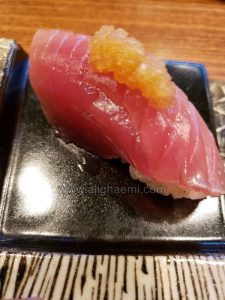
Katsuo in Vancouver, Canada
Kawahagi 皮剥 Filefish This fish reminds one of a fossil. It even looks two-dimensional. It is both a summer and winter (Japan) fish. Triggerfish is related to Filefish and sometimes called Menbo.


Kawahagi with guts
Kazunoko 数の子 Herring Roe The roe of Nishin or Herring means ‘many children.’ This yellow-ish sushi owes its colours to its origin, but also how it is either pickled or dried in the sun. It looks like a cut of fish, but in fact is a mass of roes. Kazunoko may be served to celebrate New Year.

Kazunoko in Tokyo, Japan
Kibinago 黍魚子 Silver Herring or Pond Herring It is best found and eaten in the spring. It is a ‘tiny fish.’
Kichiji キチジ Thornhead or Idiot The fish is also called Kinki in Kanto. It is fatty, meaty, bright red and rare. It dwells in deep waters and will dig a deep hole in your wallet.

Kidai 黄鯛 Yellow Seabream A variety of Seabream or Tai. It is also called Renkodai 連子鯛 or Yellow Porgy in English and can grow to 40 cms, but is usually 30 cms long. Renkodai or Yellowback Seabream (‘Grouped Seabream’), is a yellow-ish red relative of Tai and slightly softer in the mouth. It is identified by its three orange-ish lines. It is high in Mercury content and spawns in the spring and autumn. The fish is usually found year-round west of Japan, which is different from Madai, that is rarer in the summer.

Renkodai
Kihada 黄肌 Yellowfin Tuna This fish is a tropical hence its Hawaiian name, Ahi. Also called Pink Tuna, it is often used for steak and typically served slightly seared as it is less fatty than other Maguro. Ahi is a Hawaiian name, which also indicates the fish’s habitat. It can grow up to 150 kgs. Yellowfin Tuna is becoming scarce, but sources are not as depleted as Bluefin. Yellowfin has less mercury content than albacore tuna. Japanese many also call it Kihadamaguro.
Kinmedai 金目鯛 Golden Eye Snapper or Alfonsino or Splendid Alfonsino This red fish is fatty and best eaten in the winter. It has a greasy flavour. Kinmedai is related to Akamadai.

Kintokidai 金時鯛 Big Eye Snapper This is a type of red fish caught in the winter.
Kisu 鱚 Sillago Kisu is barely known outside Japan – it is fished typically in spring – where it is usually used when making tempura. It is a Whiting.
Kobanzame コバンザメ Remora This fish is named after ‘Same’ or shark because it tails sharks in order to be afforded some safety. It is an inexpensive item and typically caught alongside other catch.
Kobashira 小柱 Abductor Muscle Of Mactra It is a small sushi treat analogous to Engawa. Mactra (Bakagai) is a type of clam.

Kobashira in Tokyo, Japan
Kohada 小鰭 Gizzard Sardine Kohada is a sardine. It is one of the silver fishes and, as such, medium oily. It has an intense taste. When older it is called Konoshiro, while the smaller and younger of the genus are called Shinko. It is at its most prized at this size in the summer. Kohada is available year round.
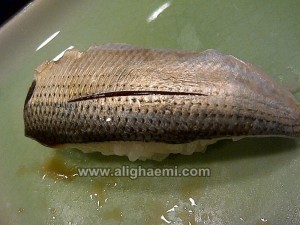
Kohada
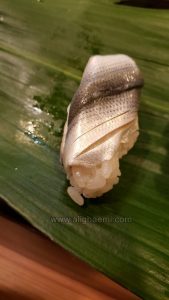
Shinko In Tokyo, Japan
Koi 鯉 Carp Koi lives in the salty waters of open seas. It comes in a variety of colours and nowadays mostly used for ornamental purposes.
Konoshiro 鰶 See Kohada
Kue クエ Longtooth Grouper Here is a fatty fish that is found in the winter. It is sometimes called Ara in Kyushu, which is different from the above-mentioned Ara. It is costly to find, catch and dine on one because it lives in reefs and caves. This fish is often used in hotpots. The name ‘kue’ means ‘to eat,’ which refers to the desirability of the fish.
Kujira 鯨 Whale Repeatedly made illegal around the world and by international organizations the Japanese maintain a whaling fleet, which they often refer to as research vessels, and have been known to circumvent the international anti-whaling will going after this mammal. The flesh is chewy, dark red to brown and heavy.
Kurage 海月 Jellyfish Rarely offered and has a neutral tasteless feeling. One can occasionally find the fish served in a Kurage Salad.
Kurodai 黒鯛 Black Snapper This type of snapper is available in summer. It is called black snapper, but is in fact grouped under the white fish. Also called Kaizu, it is not as prized as the Red Snapper.
Kuromutsu Blue Fish See Mutsu

Kuromutsu in Tokyo, Japan
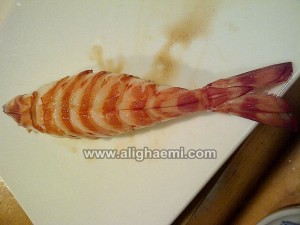
Kurumaebi 車海老 Kuruma Shrimp This giant shrimp is overwhelmingly from Japan. Approximately 90% of what is served nowadays is farmed. It is often served live. Its season is the autumn and the winter. See ‘dancing shrimp’ below.
M
Madai 真鯛 Red Seabream or Sea Bream The name literally translates to the ‘genuine tai.’ It is a fish related to Tai. This savoury fish is also eaten grilled especially since it might contain parasites. Main season for the genuine tai is spring. It can come in red ‘Akamadai’ or black ‘Kurodai’/’Chinu.’ Chidai 血鯛 is crimson sea bream. Ishidai, or Barred Knifejaw or Striped Beakfish, is the striped relative – whose stripes lessen with age – and available in the summer and autumn. Ishidai is considered the tastiest of the family. Madai of different varieties live all around the world. It is sometimes eaten with a touch of citrus.


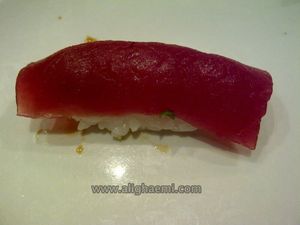
Maguro 鮪 Tuna This red Bluefin tuna is a sushi staple. It is red to crimson and mostly available during the winter. The Bluefin lives in colder waters than the yellow fin, although there are Atlantic, Pacific and Southern Bluefin populations. Strictly speaking the main type of Maguro is called Kuromaguro (‘black maguro’ from the Pacific) or Honmaguro or Shibi. Bluefin tuna is the world’s most expensive fish. It is also becoming scarce. Luckily it lives up to 40 years and can grow to over 100 kgs. Compare that to Salmon which typically lives two to five years. Bluefin is fished around Canada and the Mediterranean or between Australia and South Africa for the Southern (Minamimaguro) kind. Mebachi is Big Eye Tuna. Maguro apparently is being substituted with a large fish called Akamambou i.e. Moonfish or Opah.
Mahata 真羽太 Sea Bass or Grouper or Rock Cod This Sea Bass is Hawaiian and typically found in the winter months. It has vertical stripes on its body. One form of Grouper is fished near Portugal and available in the spring. Grouper are large fish and often as big as humans. Aka-hata is Red Hata. It is sometimes called Ara in Southwestern Japan
Makajiki 真梶木 Blue Marlin Makajiki is sometimes called Kajiki or Kurokajiki. It is becoming unpopular due to the amount of toxins in it. It might be called Marlin.
Managatsuo マナガツオ Butterfish Fished in Japan and the South China Sea, this fish is of a different shape and size than Escolar, but is often compared to it and other oilfish. It is also known as Harvestfish.
Manboh 翻車魚 Ocean Sunfish The other use for this small fish is decorative and involves an aquarium.
Masago 真砂 Smelt Fish Roe The roe is typically imported from Japan and is from Capelin. Other sources include China and Iceland. It is less expensive and less regarded than Tobiko.

Masu 鱒 Trout Masu is not considered high-end and is a close relative of Salmon. It mostly lives in freshwater lakes and rivers. This sets it apart from the sea Trout. Sakura Masu is Ocean Trout. Amago is the Spotted Trout. The fish is also used in Masuzushi.
Mebaru 眼張 Rock Fish These small fish are known for their big eyes and rocky habitat. They are found on the Northwestern coast of Japan. The fish’s name roughly alludes to ‘fish with big eyes.’
Mehikari メヒカリ Round Greeneyes This deep sea fish is so named for its large luminiscent eyes. The name means ‘lit eyes’ in Japanese. It has a rich flavour.
Mekajiki 目梶木 Swordfish This Swordfish is oily and likely toxic when eaten in large quantities. It is best eaten as a steak. An alternate name is Broadbill Swordfish.
Mejimaguro メジ鮪 Young Tuna See Maguro.
Mejina 目仁奈 Black Fish or Girella It is actually not black in colour. It is fished in the winter. It looks closer to Hamachi. Gure is a large Black Fish.
Menegi 芽ネギ Green Onion Sushi While green onion is commonly used as a garnish for sushi or sashimi this nigiri uses scallion as the topping. It is ideal for vegetarians.
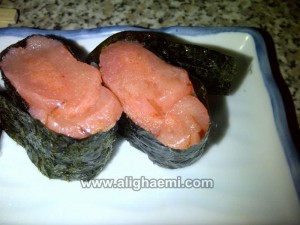
Mentaiko 明太子 Spicy Cod Roe Mentaiko is commonly the roe of Pollock, a relative of Cod. The latter is called Tarako. It is not seasonal and is not inexpensive. Mentaiko could be bitter, as well as spicy as a common recipe for its preparation is comprised of hot pepper and salt. Mentaiko is an infrequent case of a hot or spicy delicacy in Japan. Another well-known recipe in Japan is Ikamentai.
Mirugai 海松貝 Geoduck Also known as Giant Clam or Pacific Gaper or Horse Clam, Mirugai is an acquired taste that could be described as pungent. For these reasons it could be eaten with citrus, ponzu or soy sauce. It is regionally called Mirukui. It is formally called Shiromirugai or alternately Namigai.
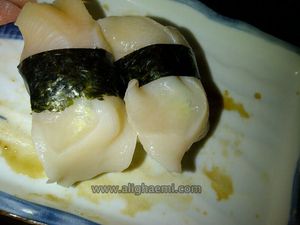
Mutsu 鯥 Shad or Big Eye Mustu can also be called Bluefish. They live off the Eastern Coast of North America. Mutsu (or Kuromutsu) is meaty, usually grilled and served with salt. It can be enjoyed year-round. Local shad is called Mamakari 飯借 in Southwestern Japan. Ma-ma, local word for ‘rice,’ and kari ‘to borrow’ denotes how the fish is so delicious one must go and borrow more rice with which to eat all the fish. Akamutsu, also called Nodoguro (in Western Japan), is Rosy Seabass. Some call Nodoguru ‘White tuna.’ Its best season is late autumn.

Mutsu with squid ink Shiso in Toronto, Canada


Nodoguru in Vancouver, Canada
N
Nama Saba 生鯖 Raw Mackerel Nama Saba is actually Saba when unmarinated and served raw. In this case, the fish has to be quite fresh. This is in contrast to ‘shime’ saba, which is marinated. Masaba 真鯖 is the Pacific mackerel.
Namako 海鼠 Sea Rat The unattractively entitled creature is also called Sea Cucumber and comes in a variety of colours such as red, black and green. Also called Akako or Kaiso in Japan it is eaten as nigiri or as a gunkan maki.
Namazu 鯰 Catfish A cheap fish. Namazu is used as soup fodder.
Nijimasu 虹鱒 Rainbow Trout This fish is related to salmon and is often farmed. It lives in both salt water and freshwater rivers or riverheads. Niji Masu is a relative of Masu.
Nishin 鰊 Herring The Nishin is Herring from the Pacific Ocean. It has a silver and bright yellow colour when readied as sushi. The taste is stronger than average. More often it is eaten as grilled or used as an ingredient in soup. Nishin is cured with soy sauce, sake and vinegar and served with pepper in the Fukushima area. This pickled herring dish, which does not contain rice, is called Nishin no sansho-zuke.
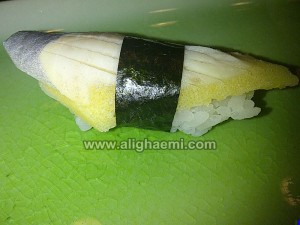
Noresore のれそれ Baby Conger Eel These very young sea eels are in season in March. Except for the eyes they are transparent and eaten as sashimi or in sunomono.
O
Odori Ebi 踊り海老 Live Shrimp Odori Ebi is eaten alive. It is not the only sea creature ingested while alive in Japan. The phrase means ‘dancing shrimp.’
Ohyo 大鮃 Halibut This is the correct Japanese word for Halibut, which people, and sushi table guides, mistakenly call Hirame. The Japanese fish obviously hail from the Pacific Ocean. It is lean.
Okoze 虎魚 Stingfish It is also known as Devil Stinger or Stonefish. This odd looking fish is best eaten in the summer. ‘Stonefish’ is also the name of the elusive Ginza bar at which the temptress of the film Odishon works.
Omaa-ru Ebi オマール Lobster This is a foreign loan word stemming from the French word ‘Homard.’
Ono Wahoo Ono means ‘good to eat’ in Hawaiian. It is somewhere between Halibut and Yellowtail. Kamasu Sawara 叺鰆 is the Japanese name.
Otoro 大とろ Fatty Tuna Belly The fattest cut of tuna’s belly. While it, along with Chutoro, was shunned in traditional Japan the fatty taste is increasingly popular due to the influence of the western palate. The Otoro is the outer fat part of the belly. Like all Toro this is an expensive item on a sushi menu.

P
Pahnagai パーナ貝 Mussel Mussels are healthy to eat as, due to their nature, they collect little toxins.
S
Saba 鯖 Mackerel A silver to red fish that is medium oily. It is typically served pre-marinated (hence, it is ‘shime’) with vinegar in order to kill or prevent parasites. Very fresh Saba can be served raw. In that form it is called Nama Saba (see above). Otherwise, Saba is also served in Chirashi or is grilled. Saba is rarely used in a roll owing to its strong taste. Unlike its Spanish cousin, Saba is found in the autumn and winter. Saba is caught in the Sea Of Japan.
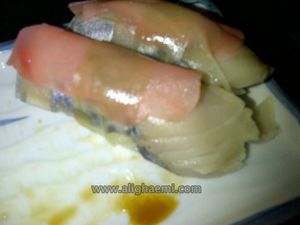

Sakana 魚 Fish
Sake 鮭 Salmon Considered a poor choice for sushi by Japanese who know, salmon has nonetheless become one of the more popular sushi items owing to its oily taste and plentiful availability. It was traditionally shunned in Japan due to it being prone to parasites. Sake is typically treated, marinated or cooked due to said parasites. It is not to be confused with Japanese sake wine. As such, even many Japanese call it ‘Salmon.’ Sake is used in various rolls like rainbow roll tazuna sushi. Most salmon is farmed and has an artificial orange colour. Sake Harasu is Salmon Belly, which is the fish’s fattier part. Shirosake 白鮭 is white or chum salmon. Rui-be is the name of a frozen salmon sashimi specialty of Hokkaido. As indicated, freezing not only helps with preserving the fish, but also assists with the parasites’ removal. Sake can also be called Shake.
Same 鮫 Shark Not eaten raw and not found at sushi restaurants unless it is under the counter. The toothless sharks are called Fuka in Western Japan.
Samekarei 鮫鰈 Shark Skin Flounder or Rough Skin Sole looks rough and unappetizing, but appearances could be deceiving. Falling under the Karei family (see above) this fish is best found in Northern Japan. It is so named because its skin looks like the rough exterior of a shark, but the body is flat and thin like the flounder family. It is eaten as sushi and has a desirabble fin or Engawa. The ends of this engawa are typically softer than Hirame’s.

Samekarei In Toronto
Sanma 秋刀魚 Japanese Mackerel This shiny fish, also known as Pike, Ocean Pike or Saury is inexpensive and available in the autumn. It also has a strong taste, a la Sardines, and eaten with a pinch of sauce. It is usually grilled however and seldom offered as sushi. The fish is becoming thinner and less prevalent due to global warming as its plant food supply withers. The kanji name means ‘autumn knife fish.’

Sawagani 沢蟹 Small Crabs They are taken from rivers.
Sawara 鰆 Japanese Spanish Mackerel This is the Japanese Aji. It is also called Japanese King Fish. It is often lightly smoked. While it appears like a white fish, it is in fact a red fish. It is best in the winter and spring period. Its name, in fact, means ‘fish of the spring’ in Japanese. T Japanese saying has it that it is impossible to resist not licking a plate that had Sawara on it. Technically, however, Sawara refers to the adult fish at over 60cms. At 40 to 50cms it is called Sagoshi. At 50 to 60cms it is called Nagi. A one-year-old fish is at approximately 48cms, a two-year-old is 68cms and three-year-old could be 78cms.


Sayori 鱵 Halfbeak This small fish is named so because of its elongated beak, with the lower one shorter than its upper one. It is served in the spring, but is rarely a favourite. Sayori, or Sauri, was majorly caught near Miyagi Prefecture of Japan. The 2011 earthquake and tsunami damaged and limited supplies. Some people call it a Needlefish, which is Datsu.

Sayori Sashimi In Toronto


Sazae 栄螺 Japanese Conch I would like to see one someday. It likely does not even have an English name. One can call it the Sea’s Snail. It has also been termed Turban Shell. It may be related to another fish called Akanishi. Sazae does not have ‘horns’ and may be considered better.
Seigo 鮬 Young Sea Bass A white fish. It is a young Suzuki.
Shako 蝦蛄 Mantis Shrimp This brownish shrimp has a stronger flavour than other shrimps. It is also written as ‘Syako.’
Shiira 鱪 Dolphin Japan’s maintains a secretive industry fishing Dolphins.
Shimaaji しま鯵 Stripped Jack It is also known as White Trevally. This Aji relative is mostly farmed nowadays. In the wild it is found in warmer waters like the Indian Ocean or southern Pacific. Like Aji it is served with green onions or ginger. The wild Shima Aji is served in the summer.

Shirako 白子 The Sperm Sac Of Cod This is eaten with hot sauce.
Shiroebi 白子 White Shrimp Also known as Shiraebi this shrimp is indeed eaten as a nigiri or maki, but more likely to be a sashimi item.
Shirauo 白魚 Icefish It is also called Whitebait. It would unfortunately be unlikely for this fish to make an appearance at a Sushi bar. When available it may become a nigiri in the spring or more likely be cooked and eaten.
Shiro Maguro 白鮪 White Tuna This is actually white Albacore Tuna and is rare at the sushi bar. It is higher in mercury content than skipjack, yellowfin or tongel. It looks like an off-white and lighter Saba.

Shishamo 柳葉魚 Willow Leaf Fish or Ocean Smelt Shishamo is a small fish, approximately 10cms long, and typically eaten grilled or fried. It is also served as nigiri.
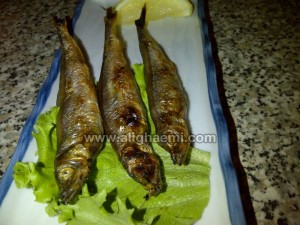
Soi そい Jacopever Soi, and its variety black soi or Kurosoi and sesame soi or Gomasoi is a variety of rockfish. It is comparable to Mebaru or Rock Fish. It could be caught near Japan, China or the Koreas. However, it is famous as a Northern Japan fish. Soi fish have thorns under the bones below the eyes, which are called ‘tear bones.’ Ainame is also from this family.
Sujiko スジコ Salmon Roe Sujiko is the same thing as Ikura; however, it was salted while still in the fish’s sac. It is typically a darker red than Ikura.

Sujiko In Toronto, Canada
Suzuki 鱸 Sea Bass A white fish with red or pink streaks that is available in the summer. The young Suzuki is called Seigo until it reaches 60 cms in length Suzuki is a popular sushi and sashimi menu item at the beginning of the course. The Chilean Sea Bass is endangered and best avoided.
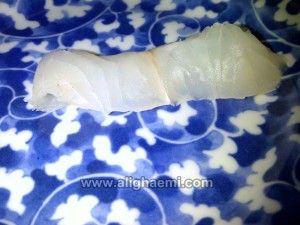
T
Tachiuo 太刀魚 Scabbard or Cutlass Fish The season for this small, but long and slender, fish is summer and autumn. It can be grilled. The fish is easily identifiable due to its whip-like tail. The fish’s name translates to ‘Great Sword Fish.’ It is sometimes simply called Tachi as ‘uo’ is another way of saying ‘fish’ in Japanese.

Tachiuo in Tokyo, Japan
Tai 鯛 Sea Bream A white fish – despite its name – that is often misidentified and misrepresented at sushi restaurants as red snapper. Tai is considered an elite nigiri item by connoisseurs. It is likely the quintessential Japanese nigiri. It is available in the winter and spring. Madai is the proper name for the Red Seabream Snapper. Tai is also eaten as part of a New Year’s meal (Osechi Ryori) as the word comprises part of the ‘medetai,’ which means ‘auspicious’ in Japanese.
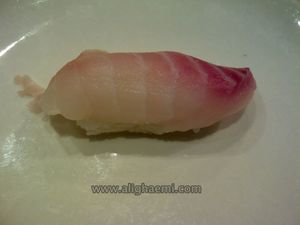
Tairagi 玉珧 Pen Shell Also called Tairagai it is a clam that resembles scallops, but is oblong and larger. It has become a rarity however. Look for it in the winter. Comb Pen Shellfish, as it is sometimes called, is found around Tokyo, Aichi and Yamagata.

Tairagi in Toronto, Canada
Tako 蛸 Octopus with tentacles The part eaten is usually the ‘legs’ and is popular as a sashimi or in a salad. At better restaurants Tako, or Madako, is served with a pinch of marine salt and citrus juice. Tako is difficult to digest in larger quantities. It is white when cooked, which is the prevalent method of eating it. Takoyaki, or grilled octopus, is another popular dish. Raw octopus is Nama Tako. Fresher Tako is typically less tough to chew.

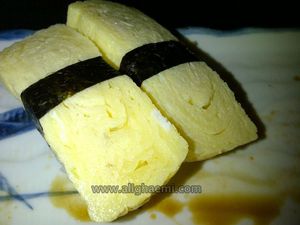
Tamago 玉子 Egg Omelette The Tamago is a sweetened and folded egg omelette. It is different than most items served as sushi as it requires preparation and cooking. It is usually served as Tamago Yaki Nigiri (‘cooked egg nigiri’). The staff may refer to it as Gyoku, a word which is derived from the alternate Japanese, or onyomi, reading of 玉. Ironically, an anecdote in Japan has it that customers could tell better sushi restaurants by the Tamago it serves.

Tara 鱈 Cod Tara is not often associated with the sushi bar. Many stocks of cod have collapsed in recent decades. Haddock is usually substituted for Cod.
Tarako 鱈子 Cod Roe It is salted roe from Cod, but occasionally is prepared from other fishes. Mentaiko is prepared from Tarako.
Tekka 鉄火 Tuna Called by this name when served as a roll as in tekkamaki. The ‘tekka’ might be comprised of pieces of tuna not utilized in tuna sushi. It is a type of Hosomaki.
Tessa てっさ Blowfish Sashimi When eaten as a Sashimi Fugu is called Tessa. Fugu is a white fish.
Tobiko 飛子 Flying Fish Roe These roes of various flying fish are small bright to dark red translucent bubbles full of goodness. The colour could also vary between gold to orange or even black or green depending on the flavour (wasabi, for instance). Served as a roll on its own or atop other sushi. These roe are tiny, but more highly regarded than Masago.

Tobiuo 飛魚 Flying Fish The many kinds of flying fish jump into the air for incredible lengths. Its meat is white and non-fatty. It is best enjoyed in the summer.
Tombo とんぼ White Tuna Tombo is often confused with Escolar. This fish is caught in the Pacific Ocean. The name means ‘dragonfly’ in Japanese – it is the fish in Shizuoka and Binchou Maguro elsewhere- and is so named for its elongated fins. Note that this lower quality fish is actually not related to tuna.
Torigai 鳥貝 Cockle Torigai is the name for saltwater clam. It is found year-round, but best in the spring. The name means ‘bird clam’ in Japanese. It may also be called Heart Clam.
Toro とろ Tuna Belly A fatty and expensive cut of tuna’s belly. It is rare and more popular in North America than in Japan. Also popular is rolls and hand rolls. The word itself means ‘to melt.’

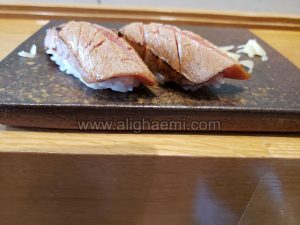
Aburitoro In Toronto
Tsubugai 螺貝 Whelk or Sea Snail A preferred source of whelk is Hokkaido in northern Japan. ‘Tsubu’ refers to small and chewy things in Japanese.

U
Umazura 馬面 Horse Face Also known as Japanese Filefish, Umazura is consumed for its liver and as sashimi.
Unagi 鰻 Fresh Water Eel Served broiled or seared and topped with tsume sauce. It is eaten with rice, called Unagiju when served in a bento box, or best eaten as the last sushi item of the meal. Unagi don or unagidon, Unagi with rice in a bowl, is a popular meal. Unaju signifies the same thing, but is served in the more formal ‘ju’ container. Unaju also implies more and better unagi in the meal. The sauce that it is served with is a mixture of salt, sugar and MSG with soy sauce. The sauce is called Tsume 詰め, which is short for Nitsume 煮つめ. Unagi is usually eaten at the end of a course of sushi due to its heavier and darker taste and feel. In Japan, a few restaurants still focus exclusively in Unagi. In January of 2013, the Japanese fresh water eel was placed on Japan’s Environment Ministry’s ‘red list’ of endangered species. Most unagi is now imported into Japan. It is most popular in the summer as it is considered a source of energy during the hotter months of Japan.
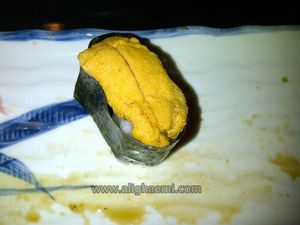
Uni ウニ/雲丹 Gonads Or Ovaries Of Male Or Female Sea Urchins One of the more expensive sushi menu items. Uni is an acquired taste. It needs cold water and, as such, could come from Northern Japan, West Coast of USA or Canada or the East Coast of either country. Canadian East Coast Uni is smaller and sweeter, while West Coast Uni is bigger and stronger in aftertaste. Good Uni is lighter in colour and has a mushy texture. Older Uni is darker and has a metallic taste. Some prefer the taste of Uni when red. Others swear by lighter Uni. A good alternative is to have it as a roll or a hand roll if one is not enthused about its pure form. It is typically eaten with a pinch of lemon juice or soy sauce. Murasaki Uni (‘Purple’ Uni), which is sometimes called Shiro Uni (‘White Uni’) is rare and rated favourably by fans. It is imported from Hokkaido, Japan and is typically larger than other uni. For whatever reason, Uni is written in Katakana usually.

East Coast (Lighter on The Left) Versus Vancouver West Coast (Darker on the Right) Uni

W
Wakasagi ワカサギ Japanese Smelt This shorter and thinner fish is found in Hokkaido and northern Japan’s lakes and rivers. It is tender and found in the dead of winter and more often used for tempura or grilled.
Warasa わらさ Young Hamachi Warasa is even younger than Inada and least tasty of the Yellowtail family.

Warasa in Narita, Japan
Z
Zuwaigani ズワイガニ Snow Crab Snow Crab is typically served on its own, but also served as gunkanmaki. It is low in fat and toxins and best found in the winter in the sea of Japan or in Hokkaido. It is also called Echizengani in Japan. The related Tarabagani or Red King Crab is more scarce and more expensive. The crab is increasingly imported from Russia.

While we are here below is a condensed list of sushi related phrases and sushi types with associated items:
Aburi 炙り This type of sushi consists of blowtorched, or ‘roasted’ meat yielding fish – in the context of this guide – that is grilled on the outside. Aburi sushi is eaten without Shoyu and Wasabi.
Agari アガリ Green Tea This phrase is exclusive to sushi bars. The origin of the word is a reference to how it was once served at red-light districts.
Baran バラン Bamboo Leaves or Grass The green leaves or grasses separating different nigiri from one another. It is nowadays substituted by plastic versions. Despite its English name referring to ‘bamboo’ the original Japanese version used grasses for the purpose described below. Baran (sometimes pronounced ‘haran’ or called Sasa or Yama – the latter word means ‘mountain’, which refers to where the grass is found) serves multiple purposes. It is decorative, it keeps different types of sushi apart and, in the old days when refrigeration was not available, acted as a mild antibiotic agent, which kept the fish and other ingredients fresher for longer periods. In previous decades the plastic Baran was even coated with antimicrobial agents. The type of sushi most popular today is Edo (Tokyo) sushi. Edo chefs preferred bamboo leaves, which are also called Sasanoha, over the grassy kind more popular in Kansai. The word ‘baran’ is a variation on ‘haran.’ The latter word is comprised of ‘ha’ meaning ‘leaf’ and ‘ran,’ which is a kind of lily. Niigata Prefecture sushi wrapped in bamboo leaves is called Sasazushi as it is convenient for trips or picnics.
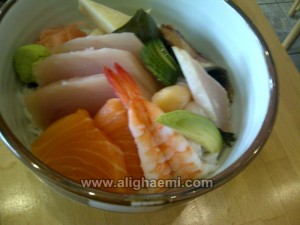
Chirashi ちらし Sushi/Zushi scattered sushi This is a bowl of rice, which is made more compactly than the more prevalent sushi rice, covered with fish, seafood or vegetables. The toppings are arranged artfully. A good chirashizushi has a top layer fully set with toppings. Other names for Chirashi are Barazushi (the fish is cut into pieces and mostly used in Okayama Prefecture) or Mazegohan (messy rice) or Sakazushi of Kagoshima (which is made with sweet local liquor of Kyushu instead of vinegar).
Cushi Chinese Sushi ‘Chinese Sushi’ is a term I have conceived to describe the modern phenomenon of Chinese owners and chefs serving sushi at their restaurants to a largely unsuspecting public. While there naturally are Chinese ‘itamae’ that serve fine sushi the majority of these establishments are denigrating the art of sushi and serving inferiority. I very much like Chinese food and would probably feel the same way if Japanese attempted to sell Chinese food.

A Villian
Ehomaki 太巻き Good Luck Roll Eho means ‘Luck’ or ‘Fortune’ in Japanese and therefore Ehomaki is ‘Lucky Roll’ or ‘Good Luck Roll.’ This long and thick (see ‘Futomaki’) roll is eaten silently in one go once a year during Setsubun, which is the celebration of the arrival of spring. Setsubun is typically on February 3rd. Ehomaki, which is claimed to have originated in Osaka, has seven ingredients like egg, cucumbers, etc. representing seven gods. The Japanese eat the Ehomaki in one go as they silently make a wish and also engage in mamemaki or Irimame bean throwing to oust demons. In popular culture Ehomaki was featured in the Izakaya Bottakuri manga and TV serial.
Futomaki 太巻き Thick Roll This roll is named so due to its oversized girth. It is the rare traditional Japanese roll and is filled with gourd, mushrooms, crab or shrimp, egg omelette and possibly radish. It may also be called Omaki or Chumaki. The thinner rolls are called Hosomaki. Hosomakis include Umekyu (umeboshi roll) or Anakyu (anago roll).
Gari ガリ Pickled Ginger The Pickled Ginger is meant to cleanse the palate and tongue between servings of different types of sushi. It is often coloured pink, but in its better form should be yellow. The pink gari is awash in dye. It is not to be eaten as food or appetizer, but used sparingly to prepare for the next type of sushi. Gari is an onomatopoeia.
Geta げた The Wooded Tray Or Board On Which Sushi Is Served Geta is also the name for the traditional wooden sandals worn in Japan. Whimsically the board at sushiya and the sandals resemble one another.
Handai はんだい The Tub For Cooking Shari Also referred to as sushi-oke (with oke being a tub or barrel like the ones used in a Japanese bath), Handai is the wooden container, which holds the sushi rice or shari.
Hara-Ichiban 腹一番 The Belly Side Of Maguro The belly of tuna, which extends to the collar, contains the most favoured parts and yields delicacies like Otoro, Chutoro and Akami.

Chutoro (left) and Otoro (right)
Hashi 箸 Chopsticks (non-disposable ones)
Hashioki 箸置き Chopstick Rest sometimes called 箸枕 or Chopstick Pillow
Hikarimono 光り物 Silvery Things is the name for the family of silver fishes like Saba, Aji and Sayori. Silver fish comprise the middle of a sushi meal nestled between white fish to start and red fish at the meal’s end.
Hoho-Niku ホホ肉 Tuna Cheeks This extremely scarce part of the tuna is an extreme rarity and prized as such. When baked and gnawed at the taste brings beef to mind.
Inarizushi 稲荷寿司 This type of sushi is a deep fried ball of tofu filled with rice. Inari is named after the Shinto god. A variation, called Chakinzushi 茶巾寿司 features a pouch which is a Japanese omelette (eggs, sugar and mirin). Chakinzushi is popular during dolls’/girls’ festival of Japan in March. ‘Chakin’ is the cloth or linen used when drinking tea. It may also be called Agesushi or ‘fried sushi.’ The fried tofu around Inari is called Abuurage.
Itamae 板前 This is the sushi restaurant term for the chef. A master sushi chef is called Itacho. Wakita would be the sushi chef’s assistant. A sushi chef may also simply be called Sushi Shokunin.
Kaitenzushi 回転寿司 This is a type of restaurant that serves sushi on plates, which either rotate on a conveyor belt or float on water by the customers. Customers are free to pick any plate they want or let it go by. This system partially replaces the need for servers. Kaitenzushi does not preclude the possibility of a special order. However, the sushi chef may offer the order to the customer by hand or place it on the belt or moat and have it sent to the customer. Depending on the set-up and size of the restaurant a Kaitenzushi restaurant may have customers sitting facing the passing food or sitting at a right angle to it. Kaitenzushi restaurants are not typically associated with high quality sushi.


Kaitenzushi in Narita, Japan

Kaitenzushi in Narita, Japan
Kappamaki 河童巻 Cucumber Roll Kappamaki is a roll with Japanese cucumbers. It is named after the mythical ‘Kappa’ or Japanese imp, which was supposed to like cucumber enough to steal it wherever it could find it. It is sometimes called Kyuri. Kappamaki is a type of Hosomakki.
Kushi Korean Sushi ‘Korean sushi’ is a term I have conceived to describe the modern phenomenon of Korean owners and chefs serving sushi at their restaurants to a largely unsuspecting public. While there naturally are Korean ‘itamae’ that serve fine sushi the majority of these establishments are denigrating the art of sushi and serving inferiority. Gimbap may be considered Korean – despite its Japanese origin – if presented as such. I like Korean food and would likely stay away were the Japanese preparing and selling Korean food.
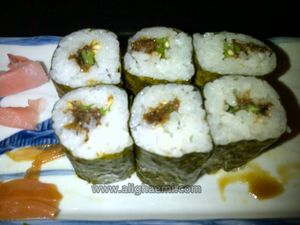
Maki 巻 Also known as makizushi. It is a sushi roll. It literally means rolled sushi. Makizushi is rice wrapped in nori (seaweed) in a cylindrical fashion topped with one or more items. The westernized version hides the seaweed wrapper inside and leaves the rice on the outside. Hosomaki are thin rolls such as one with Ume, the Japanese apricot, or kappa and are contrasted with Futomaki. Kazarimaki are the decorative rolls, which are found at special locations or during different occasions in Japan.
Umeboshi
Gunkan Maki 軍艦巻 Battleship Roll is how Ikura and Uni are often served. Others topping can also take this form. These rolls have a slightly cylindrical shape lending itself to the ‘battleship’ name.
Kakinohazushi 柿の葉ずし This type of pressed sushi (oshizushi) is wrapped in a persimmon leaf. ‘Kaki’ is persimmon and ‘ha’ is leaf in Japanese. These are more popular in the Kansai area. The leaves are supposed to act like bamboo leaves (Baran) of traditional sushi and possess anti-bacterial effects.

Kakinohazushi at Tokyo Station, Tokyo

Kakinohazushi at Tokyo Station, Tokyo

Nodoguru Kakinohazushi in Tokyo, Japan
Murasaki ムラサキ This is the term for Shoyu at the sushi restaurant. Customers in the Edo period thought soya sauce looked purple, which is murasaki in Japanese.
Mushizushi 蒸し寿司を Steamed Sushi Mushizushi is vinegared rice, but this time topped with steamed fish. This type of sushi is native to the Osaka area of Japan and is scarce enough to not be known by most Japanese. The typical recipe contains shiitake mushroom, chopped anago eels, chestnuts, shrimp and/or squids, seaweed on top and shredded egg throughout. As if steamed fish was not unusual enough in a sushi meal, this bowl is served hot making it even more exceptional. As such, this steam-cooked specialty is preferred for the colder seasons. Mushi-zushi traditionally has been served at kabuki performances or at family reunions.

Mushizushi in Osaka, Japan
Narezushi なれ鮨 Fermented sushi is the traditional, or ancestral, form of sushi. Given how refrigeration was non-existent this form of sushi was commonly prepared pre-18th Century with salted and drained fish and rice. The original Narezushi dates back to modern day Fukuoka and 1,000 years ago. Funa is the typical fish used. However, Funa does not have exclusivity for Narezushi. While salt cures the fish, vinegared rich ferments it. It was placed in barrels or boxes and water was gradually removed. The sushi would have been ready to eat, and preserved, after six months. The Kyoto and Shiga Prefecture area is where to look for narezushi today. This fish has a sour and cheese-like taste.

Neta ネタ Sushi’s Topping Neta is the name of the topping sitting atop of the rice. The most common neta is a type of fish, but it could be any other topping. The word ‘Neta’ comes from ‘source’ or ‘variety’ 種. Neta may be called Tane, or ‘material’, especially in the Tokyo area.
Nigiri 握り Vinegared Rice And Topping Nigiri is vinegared rice with a topping (called neta). This sushi has to be two fingers wide and four fingers long. A silent Japanese film from 1933 (directed byOzu Yasujiro) features a very early film footage of a serving of nigiri. The sushi is considerably bigger and wider than the aforementioned description and current sushi size. The word itself refers to something that is ‘grasped’ or ‘moulded’ in the hand. based on the Japanese verb ‘nigiru’ にぎる or 握る.
Noren 暖簾 Sushi Restaurant Entrance Curtain Noren is the curtain that is hung at the entrance to the restaurant. This fabric was originally placed there so patrons could wipe their hands clean as they enter the restaurant or wipe off the fish and the sauce as they exit. Sushi is traditionally eaten by hand.
Nori 海苔 Dried Seaweed Nori is used in Makis or Onigiri or as an ingredient for Japanese cuisine. The dried and salty Japanese algae are used to ‘roll’ sushi in. It is even available as a snack. Lower quality, or those used for purposes other than sushi, nori may also be toasted. Within the sushiya it might be called Kusa くさ. One theory has it that the word is short for Asakusa, the Tokyo district.
Obi-zuke 帯び付け This is the seaweed band or binding wrapping certain sushi to keep the rice and toppings in place.
Onigiri おにぎり Sushi Ball Or Pouch Onigiri is a ball or a triangle made with plain steamed rice, various stuffings like umeboshi (pickled Japanese apricot) and nori.
Oshibori おしぼり Hot towel Oshibori is the hot towel served at sushi bars. This has its obvious utility, but is a special tradition because sushi was traditionally eaten by hand.
Oshizushi 押し寿司 Pressed Sushi Rice Oshizushi is sushi rice and other ingredients pressed into a box or mould. It is cut in squares and often topped with konbu (a.k.a. kombu) or kelp. It is a specialty of the Osaka area of Japan. The better-known oshizushi is battera or saba oshizushi. Hako-zushi, another name for Oshizushi, is ‘boxed’ sushi. Battera (バッテラ) is the boat-shaped pressed sushi often made from saba and topped with konbu. The word is derived from the Portuguese word for ‘boat.’ Oshizushi could be Bougata Sushi (棒型寿司) where a whole fish has been pressed onto rice. Masuzushi is a type of Oshizushi made in Toyama prefecture on the Japan Sea coast. It sits on the bed of bamboo leaves. It is usually cut like a pie and then eaten. Masuzushi is also available as part of an ekiben (train station bento) in Toyama.

Oshizushi in Osaka, Japan

Masuzushi at Antenna Shop in Tokyo, Japan
Otesho 御手塩 Saucer for Soya Sauce This is an olden word for the small plate or saucer for murasaki. It is sometimes called Murachoko.
Sarashi さらし Counter Seating At Sushiya Sarashi is a variant of the verb ‘sarasu,’ which means to be exposed. It reflects the nature of seating at the counter in front of the itamae. The term is obscure.
Sashimi 刺身 Raw Fish Cuts Sashimi is cuts of raw fish that is typically served with sliced giant radish and wasabi. The sashimi assortment is best eaten with soy sauce as well. A related item is Otsukuri. This is typically a sashimi plate served with some decoration and arrangement – think sides, a tail or a head served with the meat. Otsukuri, however, is more prevalent in Kansai dialect. Takohiki and Yanagi are knives for slicing sashimi. The word sashimi means ‘pierced body.’

Sashimi display at Skytree in Tokyo, Japan
Shari シャリ Japanese sushi Rice This is lightly vinegared rice served as the bed of nigiri, and other, sushi. Shari, or shaari, actually means ‘the bones of buddha’ owing to its appearance. Alternatively, ‘zaali’ is Sanskrit for rice. Another way of saying ‘Shari’ is sushi-meshi or sumeshi (‘sushi rice’). Shari is a prepared form of Komai, which is older rice that is suited to make the nigiri stick. The particular vinegar used is ‘awase-zu’ or ‘togetherness vinegar’ for obvious reasons.
Shimazushi 島津氏 This type of sushi ‘Island Sushi’ is found on the isles of Izu (Izuoshima) such as Hachijo, which are between 80 to 600 kilometers south of Tokyo. The fish in this case is marinated in soya sauce and often infused with chili peppers. It gives the neta a brown or golden hue. It is also called Bekko Sushi or ‘Amber Sushi.’
Shiromi 白身 White Fishes The family of white fish like Hirame, Tai and Suzuki. A sushi meal should begin with Shiromi.
Shoyu or Shouyu 醤油 Soy Sauce It is derived from fermented soya beans that are mixed with dibble acids. One can also order low sodium, or low salt, ones. Many higher end Japanese restaurants brew their own.
Sugatazushi 姿寿司 Whole Fish Sushi This is when a whole fish overlays rice and is served. It may look like a battera, but in fact from head to fin of the fish is used here, albeit not eaten and left for soup or other uses. A typical fish used is Saba.
Tachigui Sushi 立食い寿司 Standing Sushi It refers to Sushi restaurants without chairs or seats at the bar. Sushi is eaten standing up. The prices are typically less expensive than average.
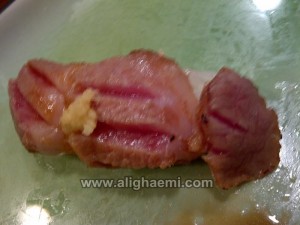
Tataki タタキ Pounded ‘Fish’ Meaning ‘pounded,’ this type of meat is lightly seared and served after marination with vinegar and garnishes. The most common form is Tuna Tataki. This type of meat is called Tataki as a reference to the ginger served on top of the meat. The Tataki, now originating from Japan, was itself likely a result of Western influence.
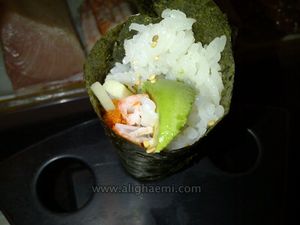
Temaki 手巻き Hand Roll Temaki is a hand roll. It is can be a whole tube or a shaped as a cone with rice and other items inside.

Temarizushi 手鞠寿司 Sushi Ball Temarizushi is a type of nigiri shaped after a round ball.
Tsuma ツマ Sliced Or Grated Daikon The white Japanese radish is a constant companion to sushi and sashimi dishes. Tsuma, sometimes called Ken, also means ‘wife’ in Japanese and is actually the source for the word’s usage here.
Uramaki 裏巻 Inside-Out Roll Uramaki is the infamous ‘inside-out roll.’ The seaweed is placed within the roll and surrounded by rice. This makes the roll more appealing to Western diners who might not like the look or taste of a traditional roll with nori or seaweed.
Usuzukuri 薄造り Thinly Sliced This term refers to fish that is thinly sliced and is akin to fish carpaccio. Fish that is served this way may be Hirame, Fugu, Tai or Kue.
Waribashi 割り箸 Chopsticks This is the name for Japanese chopsticks that are served at sushi restaurants. Chopsticks are, otherwise, known as hashi when not disposable. Japanese chopsticks are shorter than their Chinese counterpart and more round and wider than Korean ones.
Wasabi 山葵 Wasabi Plant In true form wasabi is indigenous to Japan and very expensive. The commonly sold or served ‘wasabi’ (including those in tubes) is in fact a mixture of mustard, horseradish and colourings meant to simulate the real thing. When served true wasabi is the grated root of the plant. Wasabi adds sterilizing effect and taste to one’s sushi. Within a sushiya it might simply be called Sabi サビ. It may also be called Namida なみだ or tears for obvious reasons. Wasabi was introduced to sushi meals as the olden days lacked hygiene or refrigeration.
Ya 屋 Store, Restaurant Or Place For our purpose Ya is a Restaurant as in Fuguya, which is a restaurant that serves Fugu. A restaurant that serves Sushi is Sushi-ya.
Zuke ヅケ Zuke This terms refers to fish, dominantly maguro, which is pre-soaked in soya sauce and called magurozuke. While the sushi neta is often marinated in shoyu, ‘zuke’ indicates the recipe calls for the fish to be pre-marinated.

Zukemaguro
For the Mercury contents of various fish please see the list by Japan’s Ministry Of Health, Labour And Welfare: http://www.mhlw.go.jp/english/wp/other/councils/mercury
Japan’s Ministry Of Agriculture, Forestry And Fisheries offers information and context on the wealth and variety of fish sourced and available there: http://www.maff.go.jp/e/foj/food/seafood.html
Thank-you for reading or referencing this guide. I have attempted a satisfactory job, but know that the guide is imperfect. If you can assist please do so. As a living document I will edit and update it.
Are any fish missing? What should I add? Where did I miss a turn? Use the comments’ section.
Most importantly, treat Sushi, its origins, subtleties and tradition with respect if you could. The more one learns about the history and development of the food, and the culture behind it, the more one understands why sushi’s authenticity and purity are meaningful.

Sushi Bento in Toronto, Canada
The attached below documents are downloadable versions you can save or print for your personal use:


