Apr 032011
 

The rule of thumb in recent years for the success rate of cold calling prospects or following up on mailers by telephone has been a five percent achievement. In other words, typically in these situations, 5% of prospects allow the seller to advance further in the sales process.

That ratio is now likely obsolete and too high. Nowadays, there is a whole cottage industry of experts and methodologies on how to prospect, or not to, but the fact remains that responses are less and less likely. It could be that the positive responses are at 0.5%. In other words, for every 100 prospects that receive an unsolicited call or brochure less than 1 moves forward and shows interest.

Why? What can a marketer do?

Knowledge is power. Prospectors need relevant information with which to target their customers. That means, one must call into a company in possession of much more information than before. One cannot cold call prospects without having up-to-date information. In fact, that would not even be cold calling.

The ‘need to know’ goes beyond having a name and having perused a website nowadays. Know the name, the history, the events, the news and the website’s information. Have you studied the prospects’ social media profile? Have they tweeted something? Is your pitch aligned with their needs and is it targeted and customized?
No more mass mailers. The mailing list requires customization and personalization for each an every prospect.
Every potential client is unique and the marketer needs to incorporate that in the approach or risk failure.

Read this again: http://www.alighaemi.com/wp/?p=508
Mar 292011
 

I attended the launch of Microsoft Dynamics CRM 2011* earlier today.

Dynamics CRM 2011 is really version 5.0 (should you forget how there was not a version 2.0), but Microsoft has synchronized its products’ releases nomenclature. The usual feature advances were touted. Among these were Connectivity, Familiarity and Intelligence. However, the emphasis was the ‘Social’ aspect of the release. The phrase ‘Social CRM’ was uttered more than once, as was the connectivity to the likes of LinkedIn and Twitter.

Case in point: aside from Microsoft Canada President Eric Gales, presenters and panellists were Jordan Banks, Managing Director, Facebook Canada, Jonathan Lister, Managing Director, LinkedIn Canada & Latin America, Brian Solis, author of Engage! and Paul Greenberg, author of CRM At The Speed Of Light.

The ‘Social Media’ aspect and emphasis of the new release is evident. How many companies are actually paying heed? Is there a need out there? Could it be a case of ‘build it and they will come?’ Where does the input occur? Is it hype to differentiate product? In reality, time will tell, but how many companies are actually making ‘Social Media’ integration a search criterion is one question. The answer is ‘not many.’

Earlier this year Microsoft CEO Steve Ballmer had introduced the product in a Webcast. Clearly, Microsoft is not ignoring this product.

Microsoft CRM

*I do work on behalf of Microsoft

Mar 202011
 

The word “just” creeps into many sales conversations. It should not!

Whether in the field, or more likely on the telephone, too many sales conversations include sentences like:

  • Just one more thing
  • I just wanted to reach you to say…
  • I just need a minute…

The use of the word ‘just’ is a defensive mechanism by salespeople to imply understanding on their part of the customer’s time and lack of desire and designed to send a message that the customer’s commitment (at this stage) is minimal.

Ironically, the word implies triviality, a junior status and assigns irrelevance to the topic, product/service and the person who utters it. Why would one denigrate one’s own importance, message or potential benefits of the goods or service?

On the next sales conversation just banish the word ‘just.’

Mar 182011
 

…within.

It has long been my belief that nothing can bring a company down, ruin a business or crush a corporation, but the business or company itself.
The competition cannot do it. The economy cannot do it. Natural disasters cannot do it.
Businesses are destroyed through wrong choices, betting on the wrong strategy, picking the wrong president, promoting turf wars and permitting discrimination over cooperation and collaboration and pettiness and intransigence over valuing human resources and being purposeful.

Think of Enron and its fake contracts, Nortel and the billions spent gobbling start-ups without products or a future or any of the plethora of companies that defined themselves too narrowly to address new market opportunities.

The choices that companies officially make, people and behaviours they tolerate or accept and the culture they foster determines success – not what the rest of the universe does.

Let’s explore this from a people’s perspective. A company or organization can take its destiny into its own hands and implement the means to succeed. It may choose the correct leadership, treat its customers well, align itself with the objecives and developments of its target market and also it should mandate internal collaboration.

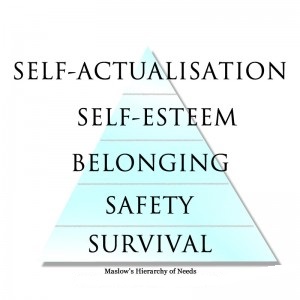
This is a must because it is not natural behaviour. People’s first instincts are themselves. Everything else only follows.

maslow-ALL-300x300

Note: Survival Of Self Comes before Belonging

Given that people assess their own selves above the organization then it is the organization’s job to ensure people cooperate and collaborate. Courtesy, support and assistance should be mandatory.

When the organization succeeds through internal ingenuity and collaboration then it is in a better position to compete externally.

Think about the implications of this. Do you agree that companies don’t have problems until they create their own?

Feb 022011


Here is a compilation video with some nifty achievements. How motivational is it to see individuals achieving these skill levels? Is it a good idea, for the rest of us to have such lofty goals in the first place? Or should we encourage and commend workmanlike behaviour given that it correlates to a majority of people? Is it unrealistic or even unmotivational to find inspiration in such feats? Or just plain fun?

Can humans walk on water?

Feb 022011
 
  • Are you subscribed to your customer and resellers blogs or tweets? Do you have a Twitter account? Share your partners public thoughts with your own followers. Ask your customers and partners about their posts. Can there be a bigger compliment?
  • Do you monitor their news and websites to see what they are posting, what their news is and what they are most proud of?
  • How could you interact better with them using Social Media?
  • Here is a thought grenade: how about inviting all, a segment of, your partners, resllers and customers to an online seminar where you facilitate a public discussion on profitable strategies and what is happening in the marketplace?
Dec 312010
 

… which means the end of the first decade and the beginning of the second decade of the 21st century. For better or worse – which is it? – time flies. Should one change?

As we reflect back on 2010 (yes, an artificial time demarcation point), what lessons do we learn for 2011? The relationship between buyer and seller, manager and employee, marketing and audience and essentially people has changed.

How are we coping with higher expectations?
How are we coping with the burgeoning knowledge of buyers?
How are we engaging the jaded audience?

Are you providing more value in a shorter span of time to your customers than the competition?
As a seller how much value are you offering beyond reactively providing information? Are you a business resource?
Are you connecting personally with your buyers? If your customer is a fan of J.D. Salinger, for example, are you forwarding a review you have written on Catcher In The Rye to them?
Are you giving just a little more? Even one percentage point of harder work is better than the competition’s, isn’t it?

The knowledge landscape has flattened. Where do we fit in for a new decade?

Dec 032010
 

Came across a light-hearted article on purchasing Customer Relationship Management.

“Because when you’re buying a new CRM system, just like when you’re buying a new car, it’s not about what you want…it’s about where you are in your life.”

CRM and cars?

Personally, I shuddered at the thought of a minivan at any stage!

Nov 282010
 

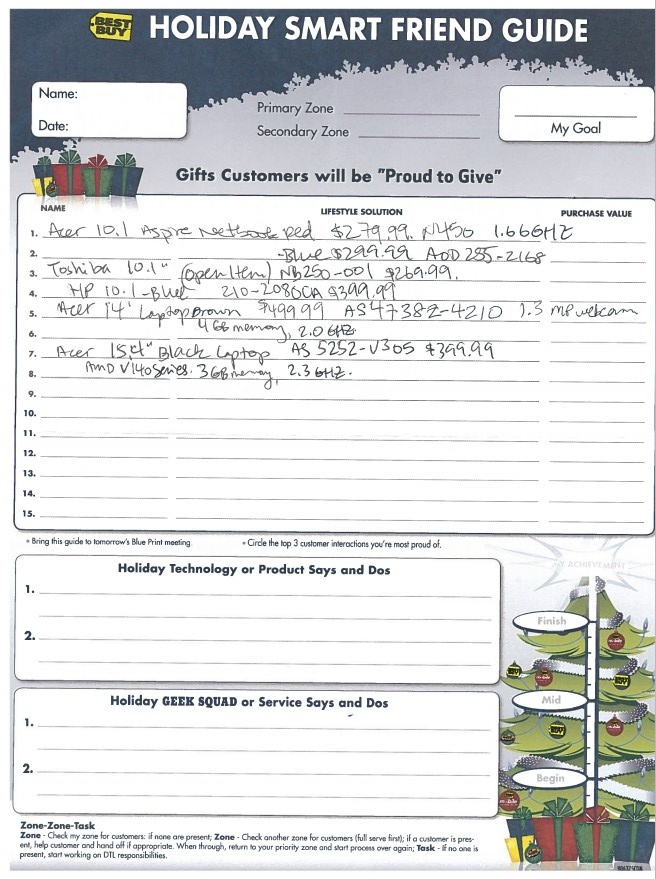
Click to see full size

Dropped by Best Buy where ‘associates’ do not work on commission (although have a host of other metrics leading to the same end-effect).

Here is what the salespeople are given to work with. Taking for granted the commercial nature of the ‘Holiday Season’ the employee hand-out encourages them to talk up products as a “Lifestyle Solution” and to “Circle The Top 3 Customer Interactions You are Most Proud Of.”

So far, par for the course, but what about “… Product Says And Dos” or the fine print instructing employees to stand in the pre-identified first zone “priority zone” before proceeding to “another zone” if the first does not have customers? Finally, they are asked to preoccupy themselves with a “task” and other “responsibilities” if no customers are present anywhere. Everything is to be performed in the order it is spelt out.

Sounds really simple. Is it too much? Is it necessary? What would the employees do without these sheets?

And yes, I was comparing those computers.

Nov 232010
 

If you want your boss to approve of you and your future request, ask for his or her advice, including seeking particulars, and then take it.

In this case, the question one poses should not be general (although that is an OK place to start), but rather one should focus on how one could be more effective on the job and with whom else one should speak. The ‘whom else’ is comprised of people a level or two above you.

Take the advice and implement with yardsticks.

Approach other senior individuals (via e-mail if possible) and ask for time to have coffee or simply to chat informally. Ask about what they are up to in the short and medium term and pivot by asking them how you could contribute and help with the endeavour. See how you can contribute to their goals and/or other goals of theirs you might have heard about. You are being helpful and proactive.

Follow up with the person and share your suggestions and ideas. Feel free to share with a larger group (in a meeting or via e-mail).
It is also appropriate for managers to e-mail the executive team promoting one’s team’s accomplishments.

Once a relationship has been established ask for advice and help regarding how to obtain the position in which you are interested. It might be a specific position or it might be a type of a role. Explain why you are a fit. Asking early on is being pro-active and gets you a leg up!