Jun 082011
 

When last we looked at what motivates employees it was through an InformationWeek survey and analysis in mid-2008. Three years later and the publication has issued an updated ranking of what matters to employees.

  • In 2008 the top three condistions of satisfaction were:
    Base Pay
    Benefits
    Challenging Job

2008 Salary Survey Three Years Ago

  • What are the top 5 criteria that employees cite as important to them (as printed in the May 30, 2011 issue) three years later?
    Base Pay
    Job And Company Stability
    Benefits
    Flexible Work Schedule
    My Opinion And Knowledge Are Valued

Note: these are presumably IT workers

The top 3 criteria are similar with ‘stability’ having crept in possibly due to the main street recession in which some of the world has been mired.
Interestingly, and perhaps coincidentally, elsewhere in that edition of the magazine, an article titled 4 Steps To Spark Innovation notes that “in the first quarter of 2011, 20% of S&P 500 companies reported that their revenue exceeded prerecession peaks. Many more will reach this milestone before the end of 2011.”

Is senior management listening? Will the stock market care? Will Wall Street/Bay Street think longer term and note what makes companies tick (think Google’s announcement regarding salaries)?


*Things That Need to Go Away: ‘motivational’ e-mails from the CFO that share prices are up or earning are either up or steady (but employment, benefits, perks or salaries will be slashed).
Jun 062011
 

One of the key means of motivating employees of any sort is managing the person as an individual. Personalizing a person’s management implies that the manager will take the time to hear out, get to know and understand the employee. In this manner, a manager can refrain from assuming a one-size-fits-all approach works for everyone in the group.

Managers need to get to know their employees. They need to know what motivates them, what they like, what their hot-buttons are and what their desires are. Then the manager may discuss what is of value to the specific person. What works for one person may not work for another.

Jun 032011
 

One of the worst behaviours in the realm of sales and sales management is discounting. The corporate euphemism is usually something along the lines of ‘providing the customer an incentive to buy.’
Hold on a second! Why does a customer need another incentive to buy if the product has benefits and offers superior advantages over the competition?
Discounting – or positively responding to such requests from potential customers – is self-defeating and bad practice. It is a negative not just for the seller either. It is also a negative for the buyer. How so?
First, giving away margin and price points upfront is rarely, if ever, a temporary situation. The new lower price is now the permanent price. A customer that has successfully obtained a lower price will demand the same going forward. Not only are customers prone to protecting their gains, but also the discounted price is perceived as the fair value price for the product or service. Any salesperson that agrees to a lower price should not be under any illusion that the loss will be made up later. There is no such thing as an introductory price anymore.
Moreover, prices are set according to costs, business plans and market conditions. Losing the required profit margin might imply incurring a loss and jeopardizing the seller’s longevity or security. Buying a customer’s business is the wrong notion.

Why is the lower price ultimately bad for the customer? It does several things. A buyer and a seller should maintain a mutually beneficial synergistic relationship. When one is threatened, the other should be concerned. The seller needs to provide after-sales support and, in most cases, enhancements, maintenance and upgrades. Furthermore, discounting tells the buyer that the initial price was dishonest and false. Not a good start to a relationship. Pricing integrity takes honesty and courage in the short-term, but is a good idea for the long-term.

    1. Maintain a healthy pipeline
    2. Allow your fair pricing policy to become your reputation
    3. Sell according to identified benefits and Return On Investment and
    4. Remember that a customer should not be a loss leader.
      Jun 012011
       

      Anne Dranitsaris is a “corporate therapist, author and creator of the Striving Styles Personality System” whose website can be found at http://strivingstyles.com/the-art-of-not-demotivating-your-employees/
      So far, so standard. Except, Ms. Dranitsaris has an intriguing theorem. She believes that leaders cannot motivate people, more specifically their employees.
      Instead, she advises leaders to refrain from demotivating employees. Imagine that, in one fell swoop she dismisses bonuses, Christmas parties, designated parking spots, Hawaiian shirt days* and… well, I am exaggerating (probably), but her notion is extraordinary and brave.

      Ms. Dranitsaris’ assertion is that motivation an emotional issue and not a rational decision. As such, it is impossible for a leader to make or create motivation. Moreover, motivating employees creates dependence.
      Instead, she advises leaders to not demotivate employees by:

      • Not overwhelming employees with work and not set an example of living (overstaying) in the office
      • Showing appreciation for employees, but not to be patronizing.
      • Not micromanage. Nit-picking leads to anxiety.
      • Not devalue. Cut back on the sarcasm and do not summarily dismiss ideas.
      • Do not allow employees to feel helpless. Nepotism, old boys network, favouritism and even fostering of competition are upsetting to employees. This last notion jives somehow with Daniel Pink’s assertion’s regarding employees and allowing them freedom, but one wonders how much Ms. Dranitsaris’ ideas coincide with Pink’s ideas that differentiate between intrinsic and extrinsic motivation.
      • Finally, she insists that employees need to know what they are doing and what is expected of them.

      How controversial is the notion that leaders cannot and should not try to directly motivate employees and that motivation should be self-directed within the right environment?


      *Things That Need To Go Away: designated parking spots and Hawaiian (or any theme) short days – unless a sales team actually wants them.

      May 112011
       

      In order for a salesperson to be successful correct execution of the company plan is a must. It is improbable for a salesperson to succeed on his own and in isolation from the company’s plans and agenda. That, however, means a salesperson needs to be the right fit in and to understand the company’s goals, time-lines and model in the first place.

      First things first. Do you have the right person in role? Is there a hunter doing a farmer’s job? Is the farmer getting paid like a hunter? Does the hunter or the farmer really understand where all of this is going? Without these motivation will be hard to come by. In fact, motivation will move in reverse.

      But let’s back up. The right person needs to be sitting in the salesperson’s chair. Some people like to be assertive and aggressively attack and ‘hunt’ for new business. Some live off of relationships and care passionately for nurturing and growing existing business.

      Do you have the right person in the right job and are they receiving the right information and context? Without these demotivation will set in. Negativity is very quickly followed by failure.
      As controversial as this statement might seem, it is management and the company’s duty to motivate, train, inform and support their salespeople. Even the most positive warrior will tune out without the right inputs and in the wrong job. Why so many companies hire ‘motivated’ people, but do nothing to sustain it is a puzzle that has something to do with laziness, stupidity and arrogance. Salespeople’s motivation and productivity does not come by accident. Give your carefully placed salespeople goals and support them with direction and clarity. Within those contexts allow for autonomy.

      Pick your people correctly and support them accordingly.

      Mar 182011
       

      …within.

      It has long been my belief that nothing can bring a company down, ruin a business or crush a corporation, but the business or company itself.
      The competition cannot do it. The economy cannot do it. Natural disasters cannot do it.
      Businesses are destroyed through wrong choices, betting on the wrong strategy, picking the wrong president, promoting turf wars and permitting discrimination over cooperation and collaboration and pettiness and intransigence over valuing human resources and being purposeful.

      Think of Enron and its fake contracts, Nortel and the billions spent gobbling start-ups without products or a future or any of the plethora of companies that defined themselves too narrowly to address new market opportunities.

      The choices that companies officially make, people and behaviours they tolerate or accept and the culture they foster determines success – not what the rest of the universe does.

      Let’s explore this from a people’s perspective. A company or organization can take its destiny into its own hands and implement the means to succeed. It may choose the correct leadership, treat its customers well, align itself with the objecives and developments of its target market and also it should mandate internal collaboration.

      This is a must because it is not natural behaviour. People’s first instincts are themselves. Everything else only follows.

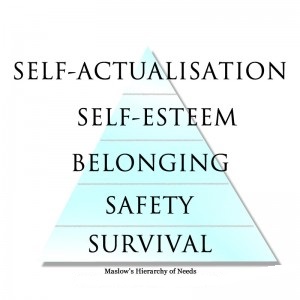
      maslow-ALL-300x300

      Note: Survival Of Self Comes before Belonging

      Given that people assess their own selves above the organization then it is the organization’s job to ensure people cooperate and collaborate. Courtesy, support and assistance should be mandatory.

      When the organization succeeds through internal ingenuity and collaboration then it is in a better position to compete externally.

      Think about the implications of this. Do you agree that companies don’t have problems until they create their own?

      Nov 282010
       

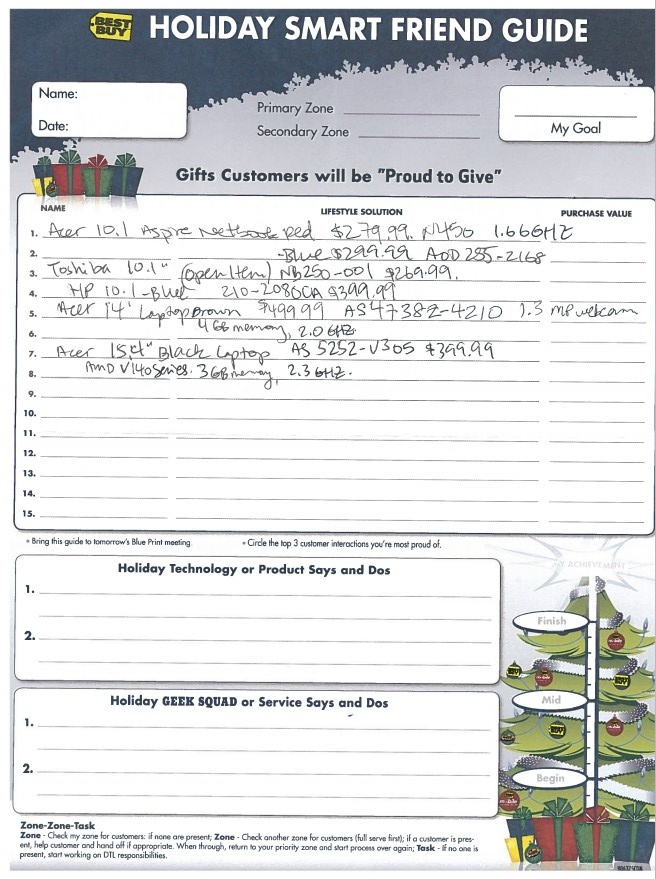
      Click to see full size

      Dropped by Best Buy where ‘associates’ do not work on commission (although have a host of other metrics leading to the same end-effect).

      Here is what the salespeople are given to work with. Taking for granted the commercial nature of the ‘Holiday Season’ the employee hand-out encourages them to talk up products as a “Lifestyle Solution” and to “Circle The Top 3 Customer Interactions You are Most Proud Of.”

      So far, par for the course, but what about “… Product Says And Dos” or the fine print instructing employees to stand in the pre-identified first zone “priority zone” before proceeding to “another zone” if the first does not have customers? Finally, they are asked to preoccupy themselves with a “task” and other “responsibilities” if no customers are present anywhere. Everything is to be performed in the order it is spelt out.

      Sounds really simple. Is it too much? Is it necessary? What would the employees do without these sheets?

      And yes, I was comparing those computers.

      Jun 292010
       

      Have you noticed how sales teams often have loud meetings and boisterous events to pump themselves up? Yet, this activity is seldom seen elsewhere. Whether the position has metrics (lawyers, doctors, truck drivers, teachers, etc.) or not (secretaries, assistants, handymen, etc.) other professions rarely engage in similar action to boost morale or pump up the group. Why?

      For one, the energetic activity has short-term effect and could be self-defeating once repeated too often. Banging a gong can rouse people and certainly draw attention, but if repeated can lose it efficacy. In other words, this type of motivation is alas short-lived.


      Why would managers follow such techniques: Perhaps the answer is a short term boost is warranted. Fair enough. Often though it is a lack of known alternatives or desperation that drives management to doing things that do not have the necessary impact. Management does not know about an alternative.


      While the earlier mentioned behaviour has merit, one wonders what sort of an action could have a longer-term effect? The answer is training/education and the feeling that one is part of something bigger and in a team environment. Both are factors in competency and self-motivating. One of the requests and needs that employee clamour for, other than base pay and a work/life balance, is education. Not only is education motivating, but also the act of knowledge helps with consistent and longer-term enthusiasm that lasts beyond the adrenaline of a loud sales meeting. Simply put, people like doing what they are good at. On the flip side, how is it that managers often ask their salespeople to do what they do not know how to?

      These are the goods for lasting motivation.

      Being good at something provides for the self-sustaining adrenaline that drives the individual. Helping someone get there, coaching them for better results and allowing them professional education are longer term solutions for motivation.

      Managers and organization should pay close attention because education credits and training are one of the pillars of sales employee satisfaction and simultaneously positively affect the salesperson’s performance. Performance clearly has to be measured, which suggests education and training need to be monitored and staff held accountable for practicing it.

      Salespeople need skills. The motivation is a by-product of being good at their jobs.

      Jun 162010
       

      A recent study by Spearhead Training in the United Kingdom offers some valuable insight into sales success. The information in the study should wrap some hard numbers around hiring practices and the mould of the successful salesperson. The conclusions were reached with the help of a study of 380 salespeople in the consumer goods industry.

      Here is the gist of the article: hard work and effort trumps talent in sales. This has implications for salespeople, managers and hiring managers. Very interestingly, this study aims to answer the oft-asked question on how to hire for and increase the chances of success in sales. What is better predictor of success in sales? Is it talent? Is it experience or is there an optimal combination of these adjectives?

      This study looked at five factors, namely competitiveness, self-motivation, conflicts in one’s career and objectives, conflict in roles i.e. negative experiences on the job such as negative prospects, and the amount of work put into the job.

      The study has several eye-opening conclusions. Self-motivated and competitive salespersons have the least number of problems. People who are naturally competitive have the least problem with motivation. There is a direct correlation between effort and success. This is followed secondly by competitiveness.

      The conclusion is that hiring managers should sniff for competitiveness above all else. The number one type to look for in a salesperson, according to this study, is a fighter. A fighter is someone who strives hard and is as competitive as possible.

      The second conclusion is to place processes in place. The study insists that people who want to and indeed do put in the effort to do the right things will succeed. One example given is setting a minimum number of mandated customer visits every month (for field salespeople) for instance.

      http://www.spearhead-training.co.uk