Ali Ghaemi

Jul 112016
 

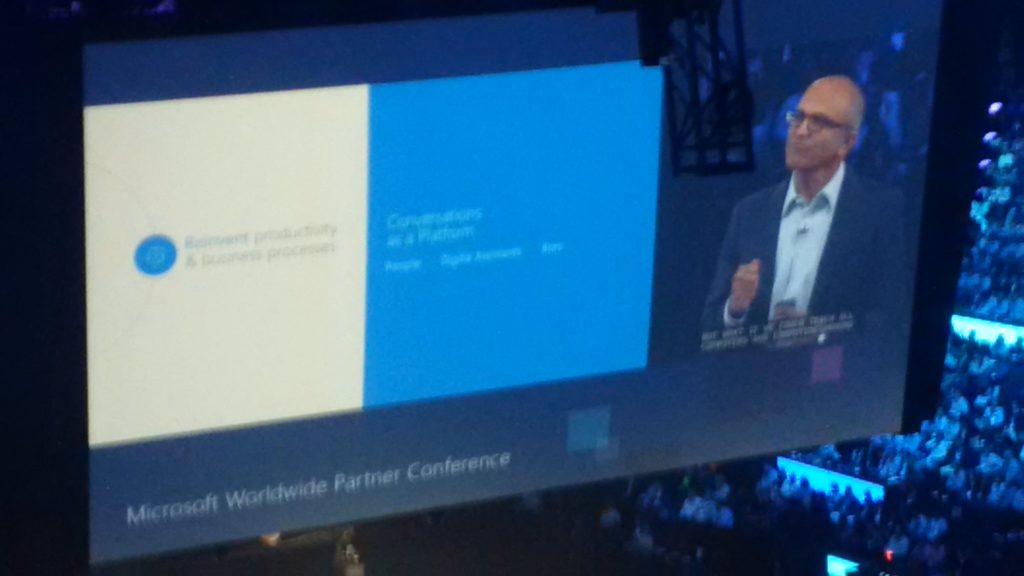
Last time Microsoft’s Worldwide Partner Conference (WPC) was in Toronto it was 2012 and then-CEO Steve Ballmer was announcing Windows 8 as his microphone kept failing the audience.

How things change with the passage of only four years. Satya Nadella is the CEO of Microsoft, Cortana is here and the show went without a hitch as far as one could tell.

The opening keynote was once again at the Metro Toronto Convention Centre, but instead of new product announcements (rumour has it that the partner application store AppSource, a rebranding, was accidentally announced prematurely) and opportunities for VARs and resellers, the keynote was one challenge after the other extended to ISVs to build on the Microsoft platforms. AvePoint’s Citizen Services is one of the first 200 apps on the new portal.

To hammer the point home that solving problems and extending technology to all corners is the route to success Nadella invited GE Chairman and CEO Jeff Immelt onto the stage to speak about how his company has become a software company. He also insisted that the era of outsourcing has come and gone and successful companies of the future must innovate with technology or die.

The aforementioned Cortana was the first product to get a name check followed by Dynamics365 from Nadella followed by less tangible, but more fundamental concepts, like “digital transformation” and the Cloud residing in every endpoint was IMG_20160711_112354 IMG_20160711_101728 IMG_20160711_101539 IMG_20160711_101451 IMG_20160711_100953 IMG_20160711_095503 IMG_20160711_095140laorrainebardeenhololens IMG_20160711_092237 IMG_20160711_085704 IMG_20160711_084512 IMG_20160711_084310 IMG_20160711_084135sequence IMG_20160711_081928also discussed. The technology is impressive, but also from a sheer cool factor point-of-view the demonstration of a virtual engine via HoloLens in collaboration with JAL (Japan’s largest airline) took the cake.

Microsoft is increasingly a platform company. That is obvious. It is interesting to watch how much Nadella and the company can extend the giant’s distinct platforms away from licensed SKUs and line items into the platform realm without going too far revenue-wise i.e. whether the balancing act can come fast enough.

By the way, did anyone see or hear any mention of the recent LinkedIn purchase? After all, it was only last month that Microsoft announced its intention to spend $26 billion (US) on the acquisition.

*I do work on behalf of AvePoint and also worked at Microsoft.

*Things That Need To Go Away: Attending Conferences Without A Clear Benefit Or Specific Outcome

Jul 022016
 

An earlier article addressed job interview questions and what to do from the perspective of an applicant.

Here we consider the interviewer and the hiring company’s perspective. If you have not read it review this article first. It speaks to the imperative of having a process and judging candidates against it.

As mentioned in those posts, asking the right questions during an interview, having a method that is followed and designed with the company’s needs in mind helps make the most fundamental decision to any company’s survival, growth and sustainability a more scientifically pertinent one. There is no more an important decision that a company makes than who to hire.

Unfortunately, too many people short-change or neglect processes and either ‘wing’ the interview, colour it with multiple biases or both. Things are so bad that an article notes how, for certain hiring decisions, machines are better than humans. This speaks to either a lack of process or the introduction – or better put: not suppressing – of personal and institutional biases.

interviewing


So what makes hiring more effective, more aligned to goals and speeds up the process for both?

To start, and as part of the suggested systemic interview process, here is a list of questions one should consider asking and situations one wants the applicant to shine in:

Q: Tell me about your previous (‘relevant job description’) success.

A: Does the answer align with what it takes where you work? Are there actual examples culled from the interviewee’s past included in the answer?

Q: Tell me about an occasion of (‘relevant job description’) failure.

A: Does the answer take responsibility, show analysis and a modicum of learning from the candidates past mistakes. Is there an actual situation where the candidate admits to failure and offers a description of the resolution?

Q: Describe a good day.

A: The ideal candidate will give a thoughtful response to how he or she works. There is not a wrong or right answer here. There is, however, a star or two for the candidate who has process, introspection and logic and displays alignment with what you believe leads to success in the job at hand.

Q: Why you?

A: Can the person articulate a convincing reason why he or she has applied and why you should accept the person’s application.

Q: Do you have questions for me?

A: Any good candidate has legitimate and considerate questions. These differ from canned questions that are irrelevant to the particular job or are so clichéd that they obviously stem from a ‘how to interview’ article.

All questions and answers should be situational unless the interviewer specifically is asking for a ’yes’ or ‘no’ answer. Moving away from hypotheticals and into the realm of experience elevates the discussion.

Crucially interviewers must remove their biases, which includes the error of judging a book by the cover or the resume. A person’s appearance, their resume’s content, gender, age and race are not always indicative of their qualification one way or the other. Be aware of one’s personal biases and leash them as best as possible. Doing so would lend itself to the validity of the hiring/interview process. Ask good questions, listen carefully and impartially to assess the responses and you have done yourself, your company and the job seeker a favour.

past-future


*Things That Need To go Away: Haphazard Interview Questions Made Up On The Fly

Jun 262016
 

Essential Features Of A Real Team

Leading Teams Hackman


Early in the book author J. Richard Hackman, who is a scholarly expert on teams and managing them and a Harvard professor, writes about his own membership experience with teams and how he will never be on a specific one again himself.

The book is written on the basis of scientific research, including situational observations, and whilst including anecdotes and stories is backed by methodical study.

At the book’s end the author marvels that not even the best team leader can make a team effective. So why write this book? It is to say that the leader creates the conditions and the probability of success tilts to the favourable.


Conditions And Not Cause And Effect


The book begins by banishing several myths whose persistence has rendered them accepted wisdom.

  • Teams whose members work harmoniously perform better than those which experience conflict
  • A primary “cause” of team dynamics is the behavioural attributes of its leader – note the emphasis on ‘cause’ as causality is refuted soon enough in the book.
  • Larger teams perform better than smaller ones due to more resources
  • The performance of teams whose membership is constant deteriorates overtime as members lose attentiveness and forgive oversights and errors.

Each of these conventional wisdoms is wrong. Does the author have your attention?

Leading Teams Setting The Stage For Great Performances begins by distinguishing between two management philosophies:

  • Minimizing risk by reducing or eliminating self-management and scripting
  • Opening up to risk in order to exploit the benefits of self-management to do more for the customers and the creativity therein

The first option comes with opportunity costs such as underutility of team members’ intelligence, initiative and other obvious losses.

The second options may lead to excess creativity and the relegation of the customer as a priority

This book asserts that effective leadership does both: “threading carefully between the poles of creativity and control.”

In that instance impressive teams with impressive leaders:

  • Serve customers well
  • Are capable performing units that get better
  • Are comprised of individuals who learn and are fulfilled

The criteria for team effectiveness, however, changes depending on the situation and with it also changes the relative weight one assigns to these factors


Conditions And Not Cause And Effect


The book lists the 5 conditions a leader puts together in order to increase the chances for the above three instances:

  1. A real team is not in name only
  2. A compelling direction
  3. An enabling structure that facilitates work and does not hinder
  4. A supportive organizational culture and context
  5. Available and ample expert coaching

The book is insistent regarding environment and contextual causes and shuns the standard cause and effect correlation; however, a leader enabling the above conditions and triggering the right moves itself is a cause and effect, right?

In the chapter on A Real Team the author almost throws a thought grenade insisting that thinking has to be regarded to teams and away from individuals (be they leaders, best salespersons, etc.). Reorienting to group level thinking is unconventional, but makes sense within the context of the book’s message. A well setup team functions well and there is less emphasis on individuals. The message is reminiscent of the lesson offered in the recently reviewed book Switch: How to Change Things When Change Is Hard. Set the scene, fix the environment and even below par individuals perform better in above par groups.

In the same chapter the four features of real teams are itemized:

  • A team task exists
  • Clear boundaries exist
  • Clearly specified authority for members to perform is defined (Which suggests inclusion of executable work, monitoring and managing the work process, designing units and arranging for organizational support and of course setting direction and objectives) and
  • Membership stability over period of time is a given

Under providing team (page 63) with a Compelling Direction the author discusses a compelling script, invitation by the leader, a consultation to start to get the direction right and then the abandonment of concepts like “empower” and “consensus.” There are shades of Daniel Pink here.

Page 72 lists the Functions And Benefits Of Good Direction in a table.
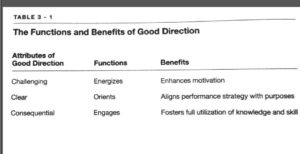
Table3-1

Page 73 elucidates Setting Direction about Means versus Ends in a table

Table 3-2

It is counterintuitive but a nuclear power plant for instance requires the type of work that is in the upper right-hand quadrant.

Overall though a direction has to be challenging and achievable.

Bottom-line key to success: lead others compellingly and paint a picture of the end-state.


Conditions And Not Cause And Effect


Under Enabling Structure, which the authors arguably place the most emphasis, the obvious ask is for the leader to create a good basis so the team does not have to create one on its own.

The three structural features for effective teamwork are on page 98 and involve dividing up tasks and coordinating subtasks, but also changing task masters in order to give all a taste of the entirety of the concept.

In terms of how much autonomy to grant there is an interesting example on page 101. The writer takes the example of a worker whose work takes place during the midnight shift. These workers have the most autonomy in how to complete their task and take on the most responsibility. Yet, and by nature, risk is introduced.

Part of offering the team an enabling structure is getting the number of members right. Here research demonstrates the number to be 4.6. In terms of mix, another myth shattered is that homogenous team are at a disadvantage. Research suggests that there is little evidence they perform better and moreover are not liable to learn as much as heterogeneous ones. Salesforce.com, for example, is one company whose hiring practice emphasizes a mix of different people and skillsets.

If a member does not play well with others, the options are to isolate the person (wasteful) or to go ahead and put them in the middle of the team (dangerous) or the best alternative is to harvest the skills of this contributor and actively help the person integrate and working around the issues.

In Chapter five the author pays attention to motivation. Intrinsic and extrinsic ones and rewards are addictive and not mutually exclusive. So getting paid a salary or a bonus, for example, add to pleasure if one already has joy.

On a personal note, being a manager several years ago I proposed that a component of my sales team’s bonus/variable come from a shared team achievement number. The idea was to promote teamwork and make everyone on the team stakeholders in the others’ success. The idea was accepted and implemented beginning with the subsequent quarter’s payout. The corporation standardized again back out of my proposal a year later, but while in place seeing the team enjoy the fruits of each other’s labours and working together was something beautiful.

What does Leading Teams suggest are the three aspects of team effectiveness:

  1. Effort
  2. Performance Strategies
  3. Level of knowledge and skill applied

Different coachings should be aligned to the above. This coaching reduces free riding and is motivational, educational and consultative.

Coaching intervention is typically at the beginning, midpoint and endpoints (review time), but the author reinforces the notion that good behaviour should be reinforced at any time.

What coaching is not is to focus on interpersonal relationships. Again going against the grain, the author does not believe harmonious relationships are that important. In fact, the opposite is true, read this twice, good performance leads to good relationships.

However, before good coaching can take place the aforementioned direction, structure and context need to be in place. By the way, good coaching is of significantly more help to well-designed teams than poorly designed ones. It is the same old story, isn’t it? The rich get richer and the poor poorer.

As already mentioned the book makes a forceful effort to refute causation and effect. That is why there is a discussion and endorsement of the concept of equifinality. That is, there are many different ways a person, team or organization can behave and still reach the same outcome. Reading this reminded this writer of the Led Zeppelin line, “Yes, there are two paths you can go by, but in the long run…”but I digress. It is interesting though that the concept means a leader has the opportunity to expand his leadership repertoire. As long as conditions are set correctly and tasks are related to the goal good things may happen.

As much as there are multiple ways to go about leadership, there are definitely several way to not go about things:

  • Misleading or lying: destroyed credibility and moral issues
  • Ape someone else’s style: embarrassing and ineffectual
  • Resisting data: sticking with one’s preferences in the face of facts and data

Best is to have one’s own style, tend to facts and vary behaviour to match
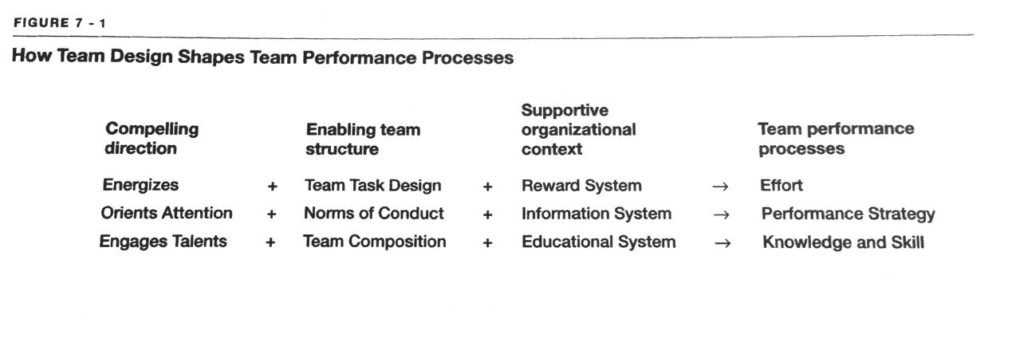
 

Table 7-1

Leading Teams is a book built on science and empirical study. This quote on page 227 speaks personally and in several ways to something I have observed and marvelled at working at corporate teams. Leadership requires courage, may engender resistance and will rock the organizational boat. Doing what is expected and managing by polling is not leadership.


Conditions And Not Cause And Effect


Page 140: “Rather than make posters or hold motivational meetings, managers would be better advised to find ways to more directly link team behaviour with team outcomes.” The best way that is done is by improving the design of the work’s team. How? Challenging work, autonomy to accomplish and feedback and coaching.

What this book is either missing or lacking by design is the many other factors involved in leading teams. There are the problems, unexpected surprises, personality and authority clashes and motivational systems. Those are left to other books and studies.

Set the conditions, tinker and adjust as you observe and gather data that a correction is required.


Jun 112016
 

Fear sells. We know that much.

What else sells? You might think ‘competence sells’ or ‘return on investment sells’ or ‘likability sells’ or even ‘fun sells,’ et cetra. However, the question of the day is whether insulting a customer sells? What about boring a customer? Does that sell?

Take a look at the following videos. In the first, a man who appears to have been in business a number of years (success?) utilizes something he calls G.U.T.S.* Sales Training Method or the *Great Un-Orthodox-Un-Traditional Techniques Of Selling Success to insult the customer into buying from him.

In this video, the world’s most humanlike automaton cranks out calls at rates that would put those embarrassingly useless automated dialing computers to shame. Is he.. could he… be successful?

What do you think?

*Things That Need To Go Away: Calling Lying, Half-Truths, Fudging Or intimidating ‘Sales.’

Jun 082016
 

In an earlier article I wrote, “Analyse your expenditure and revenue sources. Do some customers/vendors/partners cost you more than they bring in? Now is the time to discover them and ditch them. Be brave about it.”

It is a simple concept. Business is in it for the revenue and, more importantly, profitability. It is not about the sale. It is about the profitable sale. If you agree then how do companies come across unprofitable customers? The customers who make more demands than they are worth, the customers who rather bankrupt their supplier than establish a partnership, the customers who find success mutually exclusive…

There is no one to blame, but us, the sellers, the sales managers, the shortsighted companies who are the enablers of the shortsighted customer.

How does one end up there? First and foremost, the culprit is selling on price. When a customer has nothing to differentiate a vendor on then the easiest fallback is on the vendor’s price. As discussed here often there are many other differentiators you should sell on – service, after-sale service, education, reliability, industry knowledge, you!, etc. – and if you do and the customer is uninterested then you have reached the definition of the undesirable customer.

You might have come across the following anecdote about a company’s sales force:

CFO: What happens if we train them and they leave? CEO: What happens if we don’t and they stay?

Let’s turn that around to customers:

CEO: What happens if we do not discount and they go somewhere else? CFO: What happens if we do and they become our customers?

Companies need to shape up, get their chins up, become confident in their product or service and get a differentiator and acquire customers based on it. Otherwise, the cycle perpetuates itself. Is it a pipedream? Perhaps, but companies possibly have no choice either as natural selection will force their hands? Companies selling on price and acquiring customers at any cost are bound to go out of business.

Ask yourself: how are you serving your company by perpetuating a precedent-setting low, or no, profit transaction?

Then ask yourself: how are you serving your company by not understanding your customer and not articulating yourself based on it?

bad idea

Related articles:

Myth: Customers Value (The cheapest) Price Above Anything Else

Of haggling, discounting and price pressures

Not Competing On Price

*Things That Need To Go Away: Sales Managers Who Pressure Salesperson To Close The Sale At Any Cost And Salespersons Who Pressure Sales Managers To Close The Sale At Any Cost

Jun 052016
 

Does anyone need reminding that when we say a successful salesperson should have attitude, we are not taking about bad attitude. We are talking about something else.

Sales is there to align customers’ stated or latent needs with goods or services.

Here comes another pushy, rude and annoying salesperson who is doing exactly what gives the worst of the profession a bad name.

Vacuum salesman stays until 1am, leaves pile of dust

Assertiveness and persistence win. They should be coupled with the abovementioned alignment. Stunts like the one pulled by the vacuum salesperson are a black mark and unfortunately hallmark of someone who does not have a good product and is not expecting to return or repeat business.

facts

*Things That Need To Go Away: Pushy Salesperson Who Lie

May 292016
 

“There is little point in rehashing basic interview tips,” or some approximation of that thought had crossed my mind during the history of my writing on this website. There really should not be any reason to write here what anyone can find and read at numerous other sources… that is, until I participated in an interview for a job candidate earlier this month.

To be fair, there probably is no such thing as a perfect interviewer or interviewee. I paid for and worked with a professional resume writing service near the start of my career. There was a payment, an interview, a couple of back-and-forths and I was the owner of a newly minted state-of-the-art resume. That is what you would think. Except, what happened instead was that there were several criticisms of the new CV by recruiters who were receiving the document who were oblivious to how the thing was put together by a leading resume writing firm. The lesson all those years ago was that one cannot please everybody.

With that said, there are probably some interview basics to which most people agree. Especially, when interviewing for a sales position consider the interview a direct audition of your selling capability. The product is ‘you’ and the ‘buyer’ is the person interviewing you. Congratulations, you have been invited to come in. Sell yourself now. How?

  • Do your research,
  • Know the job’s requirements,
  • Be pleasant, positive, dress and speak the part,
  • Listen,
  • Given the chance, ask questions,
  • Etc.

Those are the basics.

The candidate I interviewed put together a compilation of things not to do. It might have been a case of the old ‘I am a man I can naturally sell anything’ syndrome, which unfortunately makes men grow egos too large to make many remember that respect, methodology and process remain important – or it might have been the individual in this instance.

Nonetheless, and without further ado, here are a few little tips that we all thought are by now unnecessary:

  • Be respectful of yourself, your interviewer and others in the universe
  • Know the job description and what you are required to do in it (no! you do not know the nuances of the job already better than the interviewer)
  • As a result… listen and ask thoughtful questions
  • Refrain from expressing racist, sexist or ageist opinions unless you believe in those things, are forthright and value your principles over sanity and getting a job or you are applying for a position with the Trump campaign.

I believe I already said this a couple of bullets ago, but sexism, racism and ageism have no place in our society and neither do they at a job interview or anywhere you and I want to work at…

Questions? Just ask.

Job to do and not to do

Here is a post about working with recruiters as well.

Here is a post about hiring the right salesperson.

*Things That Need To Go Away: People Who Can ‘Sell Anything And Everything’ Without Listening, Understanding Or Caring.

May 252016
 

On May 18th Bloomberg ran an article about Atlassian Software, whose sales last year topped $320 million and may reach $450 million this year, “without a single salesperson on the payroll.”

Here is the article: This $5 Billion Software Company Has No Sales Staff

This was not the first article out there on the topic and Atlassian. Others had also written about the company and its business model. An analyst also offers a cautionary note: “Though Atlassian counts more than half of the Fortune 500 as customers, no single customer accounts for more than 1% of revenue. In other words, no single client pays Atlassian more than $3.5M.” That suggests the company is hitting a ceiling in how much revenue it can derive from its customers.

This is not a rebuttal or an article that is designed to be contrarian. Like many other people I read the article with interest and appreciated a company whose product’s name, project management software Jira, is better known than the corporation behind it. Think Kleenex and Kimberly-Clark Worldwide, Inc. or Popsicles and Unilever. In today’s modern society, everyone and everything has to be justified and that includes sales professionals.

The article does note that the low sales (and marketing) expenditure came about accidentally when the company received an order off its fax machine. However, reading the article one could read into a little bit of a different story.

The company’s co-CEO states, customers “much rather be able to find the answers on the website.” That is, of course, much easier said than done. I am not referring to the power of search technology. I am referring to the power of finding, reading, understanding and not having any questions.

The company advertises. One expenditure cited is “mostly on ads.”

Another expenditure, and this is important so pay attention, is “payments to partners,” which is described as “one-fifth of that” presumably referring to the software firm’s revenue. Would it be wrong to assume partners exist to resell, the company has a channel as a model for leverage and scale and these partners have professional sales teams?

However, what was most interesting were the quotes from several executives like president Jay Simons who is quoted as saying, “lower prices and more investment in research and development to refine software, making it easier to try, understand, and purchase.” One cannot help, but notice that he, and others, are doing some selling here. He sounds like a good salesperson for his firm, doesn’t he? … Or is it just me?

What do you think?

*Things That Need To Go Away: Not Counting Public Relations, Media, Marketing Or Partners As Sales

May 232016
 

Request For Proposals are document vehicles through which private and public organizations procure goods and services. The process to use an RFP, or its variants namely Request For Quotation (RFQ) and Request For Information (RFI), are occasionally mandated by organizational policy and more often simply used to ensure the issuer receives the best and most appropriate goods and services from bidders at the most favourable terms. More completely, a RFx ensures there is clear communication between the two, or more, parties.

Naturally, the system is not fully efficient or fool proof. Additionally, resources are expended on the creation, consumption and reaction phases of a RFx. This is true to such an extent that organizations have dedicated units to creating and to answering these documents. Moreover, the process is developed to such an extent that there are consultants who write these things for organizations, sell pre-written and pre-compiled ones or websites that centralize the repository for such documentation.

Suppliers, however, do not typically like these documents. In sales circles there is little confidence that these procurement vehicles lead to business. Anecdotally, the success rate is low.

  • For one, there is nothing stopping organizations from not moving forward. There is no obligation by companies to do anything.
  • Secondly, the very fact that many organizations are bound to issuing a RFx may mean that, while a supplier has already been unofficially nominated, the buyer still has to go through the motions.
  • The most obvious reason, and the third, is that in a game to stack vendors the winning provider may have little profitability or joy to proceed. Indeed, there are several books out there on how to avoid, ignore or respond to an RFP (if one must).

No surprise then that many vendors have stopped responding to these documents. The manpower to entertain these documents and the payoff is considered unjustified.

RFP process

However, there is a time when you and your organization decide to play the odds and respond to an RFx despite the three points above.

Here are tips to increase your chances of winning the business:

  1. First and foremost be truthful in your response. It is important to describe your capabilities and qualification accurately and systematically. This not only mitigates future problems – one of which could be legal –but also allows you and the organization to focus on what you do best. The law of comparative advantages certainly applies here – not to mention your eternal soul should you believe in that sort of thing.
  2. As mentioned, sales organizations typically insist on having input into the document and its creation or having a level of prior relationship before engaging. Lead an honest internal discussion on your chances, your cost (time and money) to participate in the process and estimated profit you may derive. Regular sales factors like likelihood a solution will be adopted and a set deadline for a sale being present also apply. Is there potential additional business? Do you have the scope to offer an elastic response, which gives you and the buyer several cost, material and scope options thus increasing the odds that one of your solutions will be adopted? Speaking of which, should you be the winner your offered price will not be the accepted price. Expect to face price negotiations. Have you bracketed if needed?
  3. Think about the problem you are solving for the customer. This is a different proposition than answering the document point by point. As experts in the field, it is necessary to express your solutions and bring your know-how to bear in addition to solely addressing the questions posed. This includes understanding your audience. Is the end ‘customer’ technical? Is the end customer the manufacturing manager? Is there a financial audience that will review your proposal? Are you speaking their language?
  4. Do not be shy about selling. The sales process did not start or end with the receipt of a RFP or delivery to the customer of a RFI. In fact, sellers are often asked to present on their proposals and answer follow-up questions. It is a must that you explain what you can do, better and above and beyond the competition and how your experience and subject-matter expertise can contribute in addition to what is obvious and written in the document. Remember that your number one competitor is not your competitor, but the standard do-nothing laziness. This does not mean you have license to ignore your closest industry competitor. It is necessary to contrast yourself and to do so explicitly. Do you have differentiators that you should state even if you are not being asked explicitly to do so?
  5. Most obviously, understand the rules. There are typically pre-deadline Q&A sessions, conference calls or information sessions. You may be surprised to know how many times organizations are disqualified due to procedural errors, mismatched expectations or prohibited stipulated criteria (see ‘elasticity’ in point II). Spending some time on this factor saves time, regret and even schadenfreude later on.


On the flip side, should you decide you do not wish to proceed explain it to document issuer within the parameters of your organizational context, offer your free additional consulting and do express your wish that you work together in the future instead.

*Things That Need To Go Away: Organizations picking a supplier and subsequently issuing a RFP.

RFP

Apr 242016
 

How would you answer were one to ask you what is a hallmark of good branding? How would you respond were someone to ask you to cite an example of a successful internal organization?

Customer First Organization

The thought came to me when I realized that during the last fifteen or so years I have read about so many Cisco reorganizations that fact became fiction became legend which, in turn, became one melding into another. This is not meant to be an exercise in being an armchair expert, but the number of public, as well as less publicized, reorgs at the networking giant are widely known. Why mention Cisco? The changes are examples for inward looking organizational structures.
The most recent organizational structure has the company divided into the following divisions:

• Networking
• Security
• IOT & Applications
• Cloud Services & Platforms

One notes that the business is organized according to internal imperatives (development, engineering, marketing and fiefdoms probably) and not according to customer needs. It would indeed be the scarce customer, which would have a group or department dedicated to Cloud Services, which would be distinct and separate from IOT. The same applies to any other combination of Cisco’s four groups.
This is not a knock against Cisco, which certainly makes competitive products, or even an article about the Silicon Valley mainstay. It is about what the successful companies of the future should give thought to.
So, let us take a look at the quintessential success story of the day, namely Apple. What is Apple known for? It certainly is not divisions for computers, phones, mp3 players and operating systems. Apple is known for, wait for it, simplicity, elegance and functionality. These are things customers care for, garners their attention and for which they certainly pay extra. Moreover, all its products are sold under one roof. The Tiffany & Co. company is known for style and luxury. Customers are not expected to deal with a salesperson for earrings, another for gemstones and another for third party products. In fact, the salesperson-slash-concierge personally takes the shopper from corner to corner and ensures a seamless transition. Again, the experience is designed to be oriented towards what the customer would like and enjoy. Contrast that with HP where customers would have had to speak to different persons for printers, laptops, servers and so forth. It is no secret that HP’s star had been diminishing and the company recently threw in the towel by chopping itself into two. Ironically, the move may be a harbinger of focus and good things for the remaining parties, although past experiences do not bode well (does anyone remember Palm and 3Com, to pick a HP-related example)?

Capture

The Brand Pivot To Culture

We are here to hear an argument for creating a uniform culture that is focused on customers, for customers and based on employees winning when customers win. By definition, such a culture negates fiefdoms, internal divisions, competition and trains and rewards employees to deliver on the brand promise, but there is a catch. The brand promise too has to be focused on the customer

• Here is a brand focused on the customer: See Your Business In Our Software – Oracle (where I used to work)
• Here is another: Grow Your Company With Our Solutions – Fictional company
• Here is the reverse and one that is misguided in that it is inwardly focused: The Largest Distributor Of Cola

You see, customers do not care that you are the largest distributor of anything and least of all a certain brand. In contrast, companies do care what you can do for them. It should be about them.

Walking The Talk Of Culture

More critically, and this is actually important, there should be a supporting structure behind the outward and customer-oriented brand. Everything should be designed to support the outwardly focused branding. Aside from deliberate hiring, structure and the functional day-to-day work the company must absolutely insist on employees behaving as such. Companies must align pay, bonus and promotions accordingly. What is the sum total of the design just enumerated? Culture. A culture, which is the enabling structure for a successful company.
This would be a real shock to the system for companies, which foster internal competition, tolerate nepotism and turfs and reward managers who are in it for themselves and their egos.
However, if there is one thing you take away from this article it is this most important concept. The key is that the organizational culture will conform, follow and match what the leadership puts in place for the group. It is not about instilling the culture per se; it is about creating and moderating the enabling structures and guidance that points to the correct orientation. The analogy is that of children and their parents. Parents can say whatever they wish and could instruct their children as much as they want, but unless the walk matches the rhetoric the organization will never follow.

*Things That Need To Go Away: Arrogant Corporate Culture