Sep 072016
 

You read it correctly. The title is not a typo.

In an article that was sent to my inbox this week the author reports that it is ten times more effective to train your sales managers as opposed to your frontline sales people. The article, which seems to be based on a slightly older talk by Neil Rackham the author of the famous SPIN selling books and program for an organization called the Sales Management Association, also cites a study with the same organization. The study surveyed 161 companies about their sales budget and found that those, which allocated more than 50% of their training budget to sales managers saw the greatest increase in sales and hence the most return on investment. The degree of return increases the more of the training budget is directed at the management team.

This assumes sales managers are concentrating on being teachers and given time and mandate to transfer their knowledge onto the frontline.

Naturally, the study does not suggest or target a complete abandonment of training for salespersons. For instance, sales will still be trained upon hire and be introduced to new products or versions. Importantly, the coaching will be administered by sales management. However, if one chooses to give this premise credence, one could justify its veracity by remembering that the concept of leverage applies here as it does to maintaining a partner or reseller channel for example. After all, companies maintain a reseller channel in order to scale in a way that they could not on their own. A sales manager works with multiple salespersons at the same time. More importantly, and again if you believe this study and I always recommend examining every piece of data meticulously, the proof is in the pudding i.e. the facts speak for themselves.

It would be useful now to get some feedback or thoughts from those affected – sales people and sales managers – and from sales trainers here. The implications are important as the sales budget and companies’ revenue depend on it.

Do you agree that a more effective training budget is better deployed on sales managers than on the frontline? It is certainly novel and food for thought.

manager-training

*Things That Need To Go Away: Obligatory Sales Training With No Follow-up Or Carry-Through
Aug 082016
 

We know that Fear And Pain Avoidance sells.

We also learnt that Insulting And Boring Sell (well… maybe).

What about confusing? Does that sell? According to a study from the University Of Arkansas confusing targets via a “Disrupt-Then-Reframe” technique also sells. The research shows that keeping the technique’s order intact and the components intact are crucial.

The technique suggests confusing or ‘disrupting’ the buyer’s thought process and while they are trying to figure things out make a strong statement, which is to your benefit that claims it is all simple and easy to purchase. This goes against the traditional advice that should a customer be asking questions or not understanding the best way for a seller to go is to clarify things. This technique suggests doing the opposite of allowing the customer to figure things out.

According to the study, the rate of purchase of cards from a seller went from 35% to 65% when the salesperson announced the price of cards as “300 pennies” then went on to explain that it means “$3” before stating that “it’s a bargain.” This study also shows that resistance from those who are on the fence is not overcome through additional incentives, but through the DTR technique which disrupts the resistance when customer has purposefully been distracted.

*Things That Need To Go Away: Clever Sales Techniques That Sell Unneeded Wares

Jul 222016
 

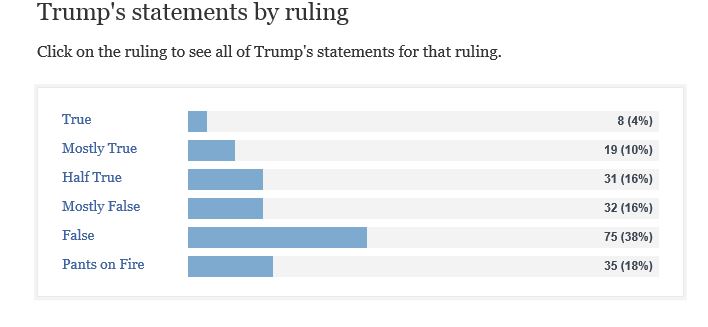
How many lies, half-truths and jibs do you recognize? They are everywhere, right?

big Mac corporate lies Trump Lies

Many people will likely consider themselves smart enough to spot the above. What about sales-related information though?

Do you enjoy learning from the various statistics and infographics on sales you find on the Internet in places like LinkedIn, Twitter or sales blogs? Do you know anyone who takes these for granted, ‘likes’ them or quotes them? The folks in charge of the Internet sites have as much inclination to check facts as Pizza Hut has to supply you and I with nutrition.

One of the books I read years ago, which still sits on my shelf, was Trust Us We’re Experts! The book narrates real-life stories of experts and so-called scientists whose claim are factually inaccurate and whose facts are anything but. Think that is bad?

Here is something worse: when the experts and data sources do not even exist… they are all made up… and people like you and I rely on them, quote them and internalize them. Look at this one:

false-sales-information

The problem? The source for the depicted ‘data’ in unknown and likely non-existent. To start, National Sales Executive Association does not exist. Go ahead and check it.

So, the next time someone disseminates one of these icons with many neat and packaged data bites question the information and ask the person to take a second look. At the very least, we will all have more free time to learn something factual instead of wasting time being fed myths.


*Things That Need To Go Away: Quoting And Reposting Infographics And Articles With Dubious Source Material


Jul 112016
 

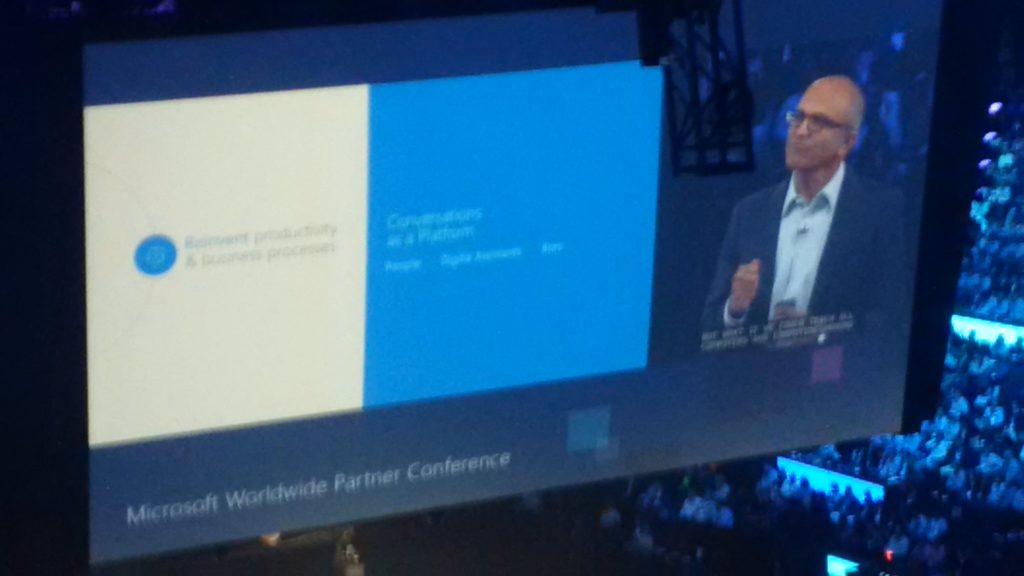
Last time Microsoft’s Worldwide Partner Conference (WPC) was in Toronto it was 2012 and then-CEO Steve Ballmer was announcing Windows 8 as his microphone kept failing the audience.

How things change with the passage of only four years. Satya Nadella is the CEO of Microsoft, Cortana is here and the show went without a hitch as far as one could tell.

The opening keynote was once again at the Metro Toronto Convention Centre, but instead of new product announcements (rumour has it that the partner application store AppSource, a rebranding, was accidentally announced prematurely) and opportunities for VARs and resellers, the keynote was one challenge after the other extended to ISVs to build on the Microsoft platforms. AvePoint’s Citizen Services is one of the first 200 apps on the new portal.

To hammer the point home that solving problems and extending technology to all corners is the route to success Nadella invited GE Chairman and CEO Jeff Immelt onto the stage to speak about how his company has become a software company. He also insisted that the era of outsourcing has come and gone and successful companies of the future must innovate with technology or die.

The aforementioned Cortana was the first product to get a name check followed by Dynamics365 from Nadella followed by less tangible, but more fundamental concepts, like “digital transformation” and the Cloud residing in every endpoint was IMG_20160711_112354 IMG_20160711_101728 IMG_20160711_101539 IMG_20160711_101451 IMG_20160711_100953 IMG_20160711_095503 IMG_20160711_095140laorrainebardeenhololens IMG_20160711_092237 IMG_20160711_085704 IMG_20160711_084512 IMG_20160711_084310 IMG_20160711_084135sequence IMG_20160711_081928also discussed. The technology is impressive, but also from a sheer cool factor point-of-view the demonstration of a virtual engine via HoloLens in collaboration with JAL (Japan’s largest airline) took the cake.


Microsoft is increasingly a platform company. That is obvious. It is interesting to watch how much Nadella and the company can extend the giant’s distinct platforms away from licensed SKUs and line items into the platform realm without going too far revenue-wise i.e. whether the balancing act can come fast enough.

By the way, did anyone see or hear any mention of the recent LinkedIn purchase? After all, it was only last month that Microsoft announced its intention to spend $26 billion (US) on the acquisition.

*I do work on behalf of AvePoint and also worked at Microsoft.

*Things That Need To Go Away: Attending Conferences Without A Clear Benefit Or Specific Outcome

Jul 022016
 

An earlier article addressed job interview questions and what to do from the perspective of an applicant.

Here we consider the interviewer and the hiring company’s perspective. If you have not read it review this article first. It speaks to the imperative of having a process and judging candidates against it.

As mentioned in those posts, asking the right questions during an interview, having a method that is followed and designed with the company’s needs in mind helps make the most fundamental decision to any company’s survival, growth and sustainability a more scientifically pertinent one. There is no more an important decision that a company makes than who to hire.

Unfortunately, too many people short-change or neglect processes and either ‘wing’ the interview, colour it with multiple biases or both. Things are so bad that an article notes how, for certain hiring decisions, machines are better than humans. This speaks to either a lack of process or the introduction – or better put: not suppressing – of personal and institutional biases.

interviewing


So what makes hiring more effective, more aligned to goals and speeds up the process for both?

To start, and as part of the suggested systemic interview process, here is a list of questions one should consider asking and situations one wants the applicant to shine in:

Q: Tell me about your previous (‘relevant job description’) success.

A: Does the answer align with what it takes where you work? Are there actual examples culled from the interviewee’s past included in the answer?

Q: Tell me about an occasion of (‘relevant job description’) failure.

A: Does the answer take responsibility, show analysis and a modicum of learning from the candidates past mistakes. Is there an actual situation where the candidate admits to failure and offers a description of the resolution?

Q: Describe a good day.

A: The ideal candidate will give a thoughtful response to how he or she works. There is not a wrong or right answer here. There is, however, a star or two for the candidate who has process, introspection and logic and displays alignment with what you believe leads to success in the job at hand.

Q: Why you?

A: Can the person articulate a convincing reason why he or she has applied and why you should accept the person’s application.

Q: Do you have questions for me?

A: Any good candidate has legitimate and considerate questions. These differ from canned questions that are irrelevant to the particular job or are so clichéd that they obviously stem from a ‘how to interview’ article.

All questions and answers should be situational unless the interviewer specifically is asking for a ’yes’ or ‘no’ answer. Moving away from hypotheticals and into the realm of experience elevates the discussion.

Crucially interviewers must remove their biases, which includes the error of judging a book by the cover or the resume. A person’s appearance, their resume’s content, gender, age and race are not always indicative of their qualification one way or the other. Be aware of one’s personal biases and leash them as best as possible. Doing so would lend itself to the validity of the hiring/interview process. Ask good questions, listen carefully and impartially to assess the responses and you have done yourself, your company and the job seeker a favour.

past-future


*Things That Need To go Away: Haphazard Interview Questions Made Up On The Fly

Jun 112016
 

Fear sells. We know that much.

What else sells? You might think ‘competence sells’ or ‘return on investment sells’ or ‘likability sells’ or even ‘fun sells,’ et cetra. However, the question of the day is whether insulting a customer sells? What about boring a customer? Does that sell?

Take a look at the following videos. In the first, a man who appears to have been in business a number of years (success?) utilizes something he calls G.U.T.S.* Sales Training Method or the *Great Un-Orthodox-Un-Traditional Techniques Of Selling Success to insult the customer into buying from him.

In this video, the world’s most humanlike automaton cranks out calls at rates that would put those embarrassingly useless automated dialing computers to shame. Is he.. could he… be successful?

What do you think?

*Things That Need To Go Away: Calling Lying, Half-Truths, Fudging Or intimidating ‘Sales.’

Jun 082016
 

In an earlier article I wrote, “Analyse your expenditure and revenue sources. Do some customers/vendors/partners cost you more than they bring in? Now is the time to discover them and ditch them. Be brave about it.”

It is a simple concept. Business is in it for the revenue and, more importantly, profitability. It is not about the sale. It is about the profitable sale. If you agree then how do companies come across unprofitable customers? The customers who make more demands than they are worth, the customers who rather bankrupt their supplier than establish a partnership, the customers who find success mutually exclusive…

There is no one to blame, but us, the sellers, the sales managers, the shortsighted companies who are the enablers of the shortsighted customer.

How does one end up there? First and foremost, the culprit is selling on price. When a customer has nothing to differentiate a vendor on then the easiest fallback is on the vendor’s price. As discussed here often there are many other differentiators you should sell on – service, after-sale service, education, reliability, industry knowledge, you!, etc. – and if you do and the customer is uninterested then you have reached the definition of the undesirable customer.

You might have come across the following anecdote about a company’s sales force:

CFO: What happens if we train them and they leave? CEO: What happens if we don’t and they stay?

Let’s turn that around to customers:

CEO: What happens if we do not discount and they go somewhere else? CFO: What happens if we do and they become our customers?

Companies need to shape up, get their chins up, become confident in their product or service and get a differentiator and acquire customers based on it. Otherwise, the cycle perpetuates itself. Is it a pipedream? Perhaps, but companies possibly have no choice either as natural selection will force their hands? Companies selling on price and acquiring customers at any cost are bound to go out of business.

Ask yourself: how are you serving your company by perpetuating a precedent-setting low, or no, profit transaction?

Then ask yourself: how are you serving your company by not understanding your customer and not articulating yourself based on it?

bad idea

Related articles:

Myth: Customers Value (The cheapest) Price Above Anything Else

Of haggling, discounting and price pressures

Not Competing On Price

*Things That Need To Go Away: Sales Managers Who Pressure Salesperson To Close The Sale At Any Cost And Salespersons Who Pressure Sales Managers To Close The Sale At Any Cost

Jun 052016
 

Does anyone need reminding that when we say a successful salesperson should have attitude, we are not taking about bad attitude. We are talking about something else.

Sales is there to align customers’ stated or latent needs with goods or services.

Here comes another pushy, rude and annoying salesperson who is doing exactly what gives the worst of the profession a bad name.

Vacuum salesman stays until 1am, leaves pile of dust

Assertiveness and persistence win. They should be coupled with the abovementioned alignment. Stunts like the one pulled by the vacuum salesperson are a black mark and unfortunately hallmark of someone who does not have a good product and is not expecting to return or repeat business.

facts

*Things That Need To Go Away: Pushy Salesperson Who Lie

May 292016
 

“There is little point in rehashing basic interview tips,” or some approximation of that thought had crossed my mind during the history of my writing on this website. There really should not be any reason to write here what anyone can find and read at numerous other sources… that is, until I participated in an interview for a job candidate earlier this month.

To be fair, there probably is no such thing as a perfect interviewer or interviewee. I paid for and worked with a professional resume writing service near the start of my career. There was a payment, an interview, a couple of back-and-forths and I was the owner of a newly minted state-of-the-art resume. That is what you would think. Except, what happened instead was that there were several criticisms of the new CV by recruiters who were receiving the document who were oblivious to how the thing was put together by a leading resume writing firm. The lesson all those years ago was that one cannot please everybody.

With that said, there are probably some interview basics to which most people agree. Especially, when interviewing for a sales position consider the interview a direct audition of your selling capability. The product is ‘you’ and the ‘buyer’ is the person interviewing you. Congratulations, you have been invited to come in. Sell yourself now. How?

  • Do your research,
  • Know the job’s requirements,
  • Be pleasant, positive, dress and speak the part,
  • Listen,
  • Given the chance, ask questions,
  • Etc.

Those are the basics.

The candidate I interviewed put together a compilation of things not to do. It might have been a case of the old ‘I am a man I can naturally sell anything’ syndrome, which unfortunately makes men grow egos too large to make many remember that respect, methodology and process remain important – or it might have been the individual in this instance.

Nonetheless, and without further ado, here are a few little tips that we all thought are by now unnecessary:

  • Be respectful of yourself, your interviewer and others in the universe
  • Know the job description and what you are required to do in it (no! you do not know the nuances of the job already better than the interviewer)
  • As a result… listen and ask thoughtful questions
  • Refrain from expressing racist, sexist or ageist opinions unless you believe in those things, are forthright and value your principles over sanity and getting a job or you are applying for a position with the Trump campaign.

I believe I already said this a couple of bullets ago, but sexism, racism and ageism have no place in our society and neither do they at a job interview or anywhere you and I want to work at…

Questions? Just ask.

Job to do and not to do

Here is a post about working with recruiters as well.

Here is a post about hiring the right salesperson.

*Things That Need To Go Away: People Who Can ‘Sell Anything And Everything’ Without Listening, Understanding Or Caring.